4 Reasons Why Facial Recognition Payments are Popular in China
Quick Insight: China’s major digital payment platforms have spent the past two years pushing face recognition payment terminals into every corner of retail. The reason is straightforward: a biometric payment device cuts checkout time from 60 seconds to under 3 seconds, operates without phones or cards, and costs 80% less than traditional self-service kiosks. With recognition accuracy above 99.9% and 3D structured light cameras that reject photos and masks, facial recognition POS machines have moved from pilot projects to standard checkout infrastructure. For retailers battling labor costs and queue congestion, smart payment hardware is no longer experimental—it is the next default.
The Rise of Face Recognition Payment in China
When the country’s leading digital payment providers began rolling out desktop face payment cash registers, the market responded immediately. One platform launched a compact unit; another followed with a desktop device; a third unveiled its own face scan POS solution at a major self-service expo. Within months, these contactless payment kiosk units appeared in bakeries, convenience stores, pharmacies, and quick-serve restaurants across the country.
The three major payment giants have been making concentrated efforts to boost “pay with faces” in the commercial field. The question is: why?
Metric
Value
Recognition Accuracy
99.9%+
Per Transaction
<3s
Cost Reduction vs Legacy Kiosks
80%
Global Market Size 2025
$8.2B
The Reason Why Equipment with Face Recognition Payment Technology Is Increasingly Popular
1. Technology Maturity of Face Recognition
From the perspective of technology maturity, face recognition payment terminals launched by these platforms mostly use 3D structured light cameras and artificial intelligence algorithms. The face recognition algorithm accurately measures the 3-dimensional information of human faces such as the depth of the face and the height of the nose by light distance.
At the same time, combined with live detection technology and big data risk control systems, the biometric payment device can quickly and accurately capture facial features and reject 2D images in photos and video. The recognition accuracy is above 99.9%, reaching financial-level security.
The facial recognition POS machine also has deep learning ability. It can remember the face of the regular customer. After paying with face, this customer does not need to input the mobile phone number next time.
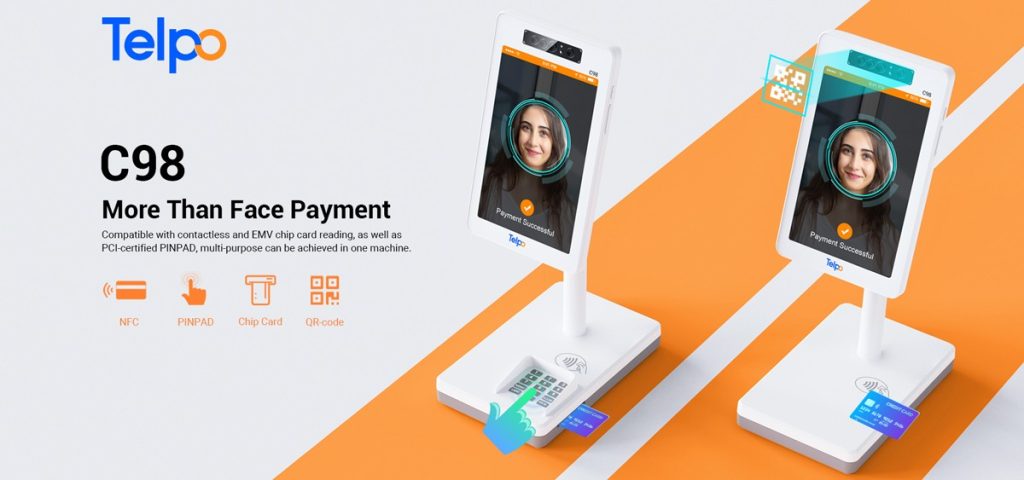
Telpo face recognition payment terminalTelpo C9 is also equipped with a 3D structured light camera, which can intelligently and accurately recognize faces and effectively defend against 3D masks or print photos.
2. Easy to operate
From the point of operability, these face payment cashier machine with face scanner are compact, but they can be integrated with multiple payment methods such as face recognition and QR-code scanning.
Users only need to stand in front of this kind of smart payment hardware and align the face recognition camera. It automatically completes the identification and payment. The whole process takes only a few seconds. In the case that the user’s mobile phone has no power, the network has no signal, or is inconvenient to take the mobile phone, the face payment can provide users with various convenient payment options. This modern system has greater appeal to younger consumers.
3. Improving the In-store Efficiency
From the perspective of improving store efficiency, the face scan POSterminal can speed up checkout dramatically. If it takes 60 seconds to settle 10 items with traditional methods, the face recognition payment terminal can complete the same batch in under 10 seconds. After introducing brush-face payment, one of the most famous bakery chains in China increased checkout efficiency by more than 60%, while reducing labor costs.
One attendant can monitor multiple contactless payment kiosk units simultaneously, shifting staff from transaction processing to higher-value tasks such as food preparation and customer assistance.
4. Introduction Cost
In terms of cost of introduction, the general self-service payment machine with face recognition used to be expensive, so general merchants could not afford it. The desktop face payment cash register changes this equation. It is only one-tenth the size of a traditional self-service machine. Plug and play, with no need to install additional development plug-ins, saving up to 80% of the cost. Small retailers can now deploy biometric payment devices without enterprise-level budgets.
Global Market Outlook for Biometric Payment Devices
The global face-swiping payment market was valued at approximately USD 8.2 billion in 2025 and is projected to reach USD 45.8 billion by 2034, growing at a CAGR of 21.06%. The broader biometric POS terminal market is expected to expand by USD 22.6 billion between 2025 and 2030 at a CAGR of 23.9%, with retail as the fastest-growing end-user segment.
At the International Organization for Standardization (ISO) meeting, biometric international standards led by Chinese companies were approved by many countries. The reason domestic players have gained influence on international standards is the maturity of local 3D structured light, AI algorithm, and hardware manufacturing ecosystems.
At the same time, China is also the largest consumer market for biometric devices. Face recognition smart hardware is now used in retail catering, smart security, smart medical, and public transit scenarios. Major quick-serve chains, pharmacy networks, and convenience stores have introduced facial recognition kiosks and POS machines to handle peak-hour traffic and reduce dependency on manual checkout.
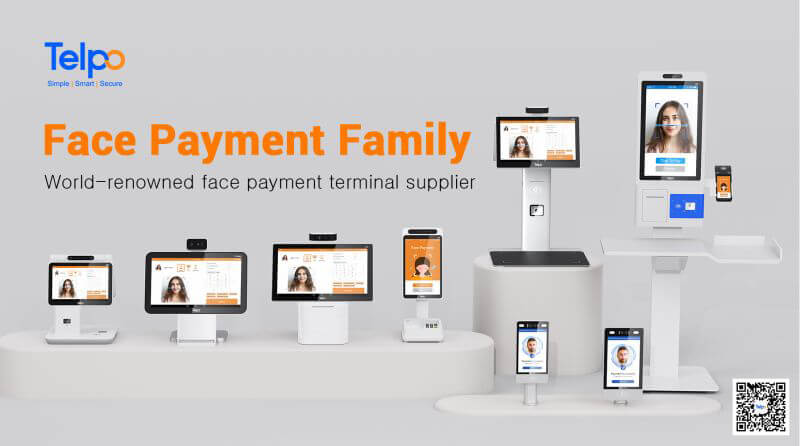
Telpo face recognition payment terminal
Conclusion
Face recognition technology brings consumers a more convenient experience and brings business upgrades to merchants. For retailers evaluating smart payment hardware, the decision criteria are clear: recognition accuracy above 99.9%, financial-grade security, plug-and-play deployment, and multi-payment integration in a compact footprint.
Telpo is a professional smart payment hardware partner with 26 years of ODM experience. It provides EFT-POS, cash registers, biometric devices, face recognition payment terminals, self-service kiosks, and bus validators. Telpo has served more than 1,000 customers abroad, including government, banks, telecom operators, police stations, retail shops, and offices. Telpo adheres to R&D and innovation, aiming to provide more intelligent hardware for global partners.
The Telpo C9face recognition payment terminal is equipped with a 3D structured light camera for accurate, secure face authentication. Welcome to contact us for more details. We have confidence that Telpo will not let you down.
Ready to deploy face recognition payment terminals in your retail chain?Contact Telpo to discuss TPS650 specifications, OEM customization, and volume pricing for biometric payment devices.
Tag: Face Recognition, cash register,payment,Dragonfly,face scanner,China,biometrics,smart hardware,Self-service,WeChat
FAQ
What is a face recognition payment terminal?
A face recognition payment terminal is a biometric payment device that authenticates transactions by scanning and matching a customer’s facial features. Equipped with 3D structured light cameras and AI algorithms, these terminals capture depth data from the face to prevent spoofing by photos or videos, achieving recognition accuracy above 99.9% and meeting financial-level security standards.
How does a face scan POS improve checkout speed?
A face scan POS improves checkout speed by eliminating the need for physical cards or mobile phones. The customer simply stands in front of the facial recognition POS machine, and the device completes identification and payment in under three seconds. Retailers report checkout efficiency gains of more than 60% after deploying these smart payment hardware units.
What makes 3D structured light cameras more secure than 2D cameras?
3D structured light cameras project a pattern of light onto the face and measure the distortion to capture depth information such as nose height and facial contours. Combined with liveness detection and AI anti-spoofing, they reject 2D photos, printed images, and video replay attacks. This is why face payment cash registers using 3D structured light technology reach financial-grade security with accuracy above 99.9%.
What industries use smart payment hardware with face recognition?
Smart payment hardware with face recognition is deployed across retail, quick-service restaurants, convenience stores, smart healthcare, and public transit. In China, major quick-serve chains, pharmacy networks, and convenience stores have adopted face scan POS systems to speed up peak-hour throughput and reduce labor dependency.
Does face recognition payment support multiple payment methods?
Yes. Most modern face recognition payment terminals of Telpo integrate multiple payment methods into one compact unit. In addition to face-scan authentication, they support QR-code scanning, NFC tap-to-pay, and traditional card reading. This flexibility ensures the device serves all customer preferences in a single footprint.
Why is China the leading market for biometric payment devices?
China leads the biometric payment device market because of mature domestic 3D structured light camera supply chains, high mobile payment penetration, and strong regulatory support for financial-grade biometrics. The country also holds influential roles in international biometric standards, and its retail sector actively seeks frictionless checkout solutions to combat rising labor costs.