
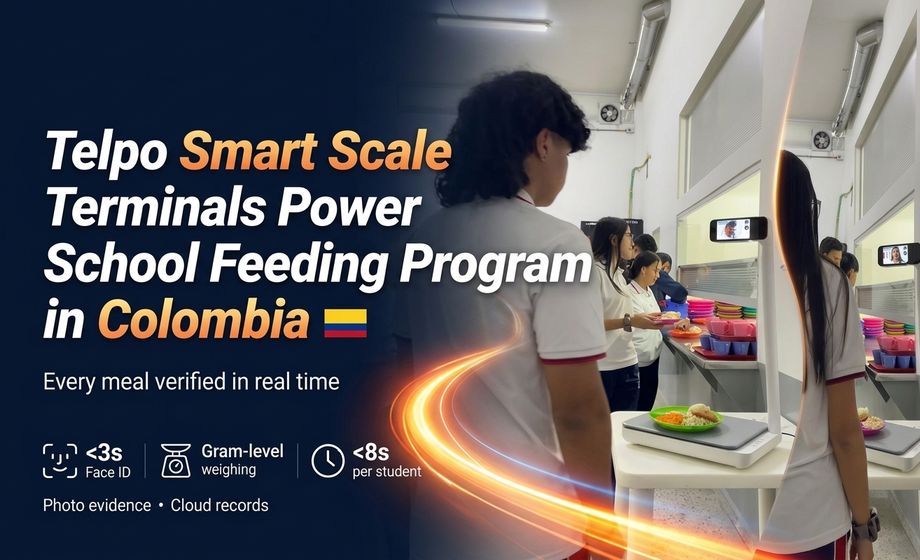
Case Overview
| Field | Details |
| Country | Colombia, South America |
| Industry | Public-sector catering, school dining, institutional canteens |
| Program Context | Colombia’s national school feeding program (PAE), one of the largest in Latin America — 5.9 million beneficiaries in 2023 |
| Application | Identity-verified meal distribution, portion weighing, delivery traceability |
| Product | ODM-customized Telpo TPS652 AI checkout machine (weighing + facial recognition) |
| Key Features | 2MP facial recognition camera (<3s), self-developed 5MP AI vision camera, built-in precision scale (30 kg / 10 g), LED fill light, voice prompts, photo evidence capture, Android 11, offline-capable |
| Outcome | Tens of thousands of verified meal deliveries across pilot departments; paper logging replaced by real-time, auditable records |
School meal programs are among the world’s largest food-service operations: at least 466 million children across 107 countries receive school meals, backed by roughly US$84 billion in annual global investment, according to the WFP State of School Feeding Worldwide 2024. Colombia’s Programa de Alimentación Escolar (PAE) is one of the region’s largest, reaching 5.9 million students — 79.4% of enrolled children — in 2023, with the government targeting 6.2 million in 2026 under a budget near 3 trillion pesos (Radio Nacional de Colombia, March 2026).
The harder question is not how many meals are budgeted, but how many actually reach the right child. Working with a Colombian technology partner — whose identification and traceability algorithms run on the terminal — Telpo provided the ODM hardware foundation that answers that question with data instead of paper records.
The Challenge: Millions of Meals Are Served Daily — Few Are Provably Delivered
Paper rosters, manual checkmarks, and visual portion estimates remain the default operating mode in many national school feeding programs. The result: reports arrive late, data cannot be cross-checked, and accountability depends on trust rather than evidence.
Three structural problems shaped the requirements for this deployment:
- Fraud and leakage are documented, not hypothetical.Colombia’s Comptroller General has recorded tens of billions of pesos in fiscal irregularities tied to school feeding contracts, including 153 formal processes in 2021 alone (Contraloría data compiled by ANDES). Under-portioning, proxy collection, and diverted rations are difficult to detect without per-delivery evidence — who received what, weighed in grams, at what time.
- Verification must be faster than the serving line. Meal windows are short. Any identification step that takes more than a few seconds becomes a bottleneck, and bottlenecks get bypassed — which defeats the control.
Beneficiaries are minors. Identification must work reliably without storing children’s photographs, and must satisfy local personal data protection regulation (Ley 1581 de 2012) — a hard requirement for any public-sector tender. For providers of biometric identity solutions, this means privacy-by-design is a prerequisite, not an optional feature.
The requirement set: a purpose-built self-checkout dining solution — contactless biometric identification, gram-accurate weighing, photographic evidence, offline resilience, and an open platform a local software partner could build on.
The Solution: An ODM AI Checkout Machine Engineered for Compliance and Speed
The deployed terminal is an ODM AI checkout machine built on the Telpo TPS652 platform — an Android-based smart scale customized through Telpo’s ODM program for this project’s compliance and workflow requirements.
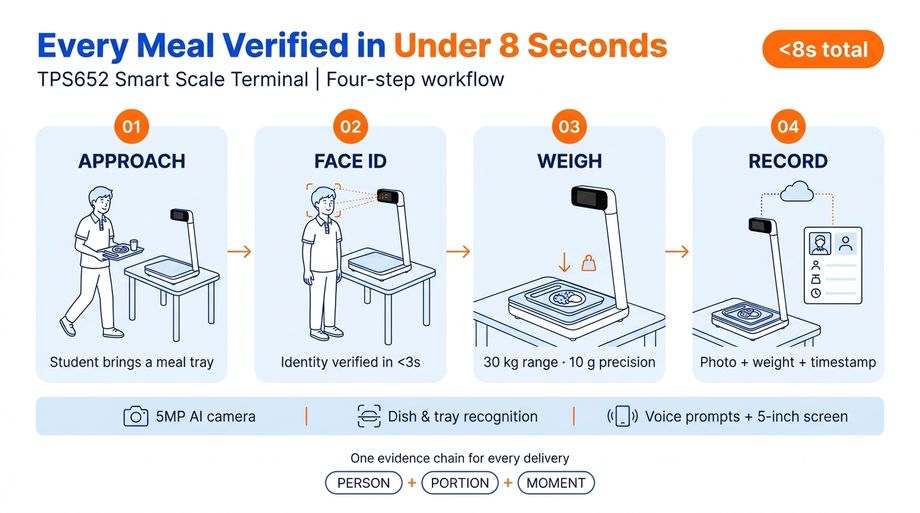
How Is Each Student Identified Without Storing Photos?
The TPS652 smart scale terminal integrates a 2MP facial recognition camera with a high-intensity LED fill light, identifying each student in under 3 seconds. Through firmware-level ODM customization, the identification pipeline generates encrypted biometric templates rather than storing facial images — satisfying child-data-privacy requirements while maintaining recognition accuracy. This privacy-by-design approach runs through Telpo’s broader face recognition solutions portfolio, where compliance-ready architecture is a standard engineering principle.
How Does the Terminal Weigh Every Portion Accurately?
The TPS652 ODM scale terminal combines an AI weight machine, a POS integrated weighing scale, and a self-checkout workflow in one terminal. Its self-developed scale module offers a 30 kg weighing range with 10 g precision. As each student places a tray on the terminal, the system weighs their portion and records the exact gram weight in real time. Combined with identity and timestamp, every delivery produces a three-part evidence chain — person, portion, and moment — replacing visual estimation with measurable data.
How Does AI Vision Create Evidence for Every Delivery?
A self-developed 5MP high-angle AI camera powers Telpo’s AI food recognition capability — identifying dishes and trays automatically — and captures photographic evidence of each delivered plate, giving operators and auditors an image-backed record per delivery. Voice prompts and a 5-inch touchscreen guide canteen staff with minimal training.
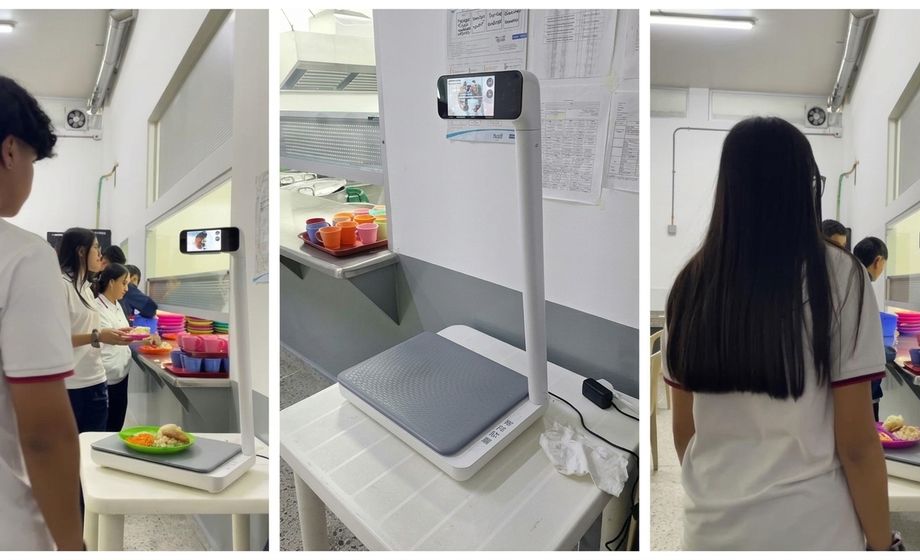
Can the Terminal Keep Working Without Reliable Connectivity?
Yes. The system is offline-first by design. Terminals continue registering deliveries without a network connection and automatically synchronize all records with the partner’s cloud platform once connectivity returns — essential for rural schools in low-bandwidth regions.
How Was the Hardware Customized for This Project?
The project shows the depth of Telpo’s ODM capability as a customized POS manufacturer: hardware configuration (camera and scale integration, fill light, speaker), firmware behavior (privacy-compliant biometric handling), and branding were all tailored to the partner’s specification, with POS machine design and engineering teams supporting the partner end to end. Running Android 11 with 2GB + 8GB memory, the TPS652 offers Ethernet, USB, and Micro-USB interfaces plus SDK and API support for secondary development, so the partner’s platform integrates the device directly and extends functionality as the program scales.
The Results: From Paper Logs to Real-Time Oversight
Verifiable traceability. Every delivery is registered with identity, gram weight, timestamp, and photographic evidence — auditable in real time instead of reconstructed from paper weeks later.
Line-friendly speed. A complete verification cycle takes under 8 seconds per student; a single terminal can serve a full school’s lunch window without building queues.
Proactive supervision. The platform flags anomalies as they happen — missed deliveries, shortfalls against the registered beneficiary list, unusual patterns — shifting oversight from reactive paper audits to proactive, data-driven management.
Lower supervision cost. Technology-assisted verification costs a fraction of conventional manual supervision of public catering contracts, making regional-scale deployment economically viable.
Documented field acceptance. During pilots, real-time delivery notifications to families increased engagement and improved daily registration completeness — when parents can see delivery data, trust in the program grows.
What Does This School Deployment Mean for Digital Dining?
The same requirements — identity verification, portion weighing, evidence capture, open integration — apply to corporate canteens, hospitals, retirement homes, and government-subsidized catering: essentially any smart restaurant system where accountability and speed must coexist.
Smart restaurant systems are moving toward AI recognition terminals that handle identification and settlement without dedicated cashiers, scales that turn “about a portion” into an exact number, and platforms giving operators live visibility across every serving point. As a smart dining solution, the architecture that verifies a school lunch can power self-checkout dining across enterprise campuses, food courts, and institutional kitchens — the same model behind today’s self-checkout restaurant concepts. A digital dining POS system anchored by recognition and weighing is becoming core dining infrastructure, not a premium add-on.
For integrators evaluating self-checkout dining solutions, the lesson from Colombia is that the winning combination is an open, compliance-ready, production-proven hardware foundation — not a single closed device.
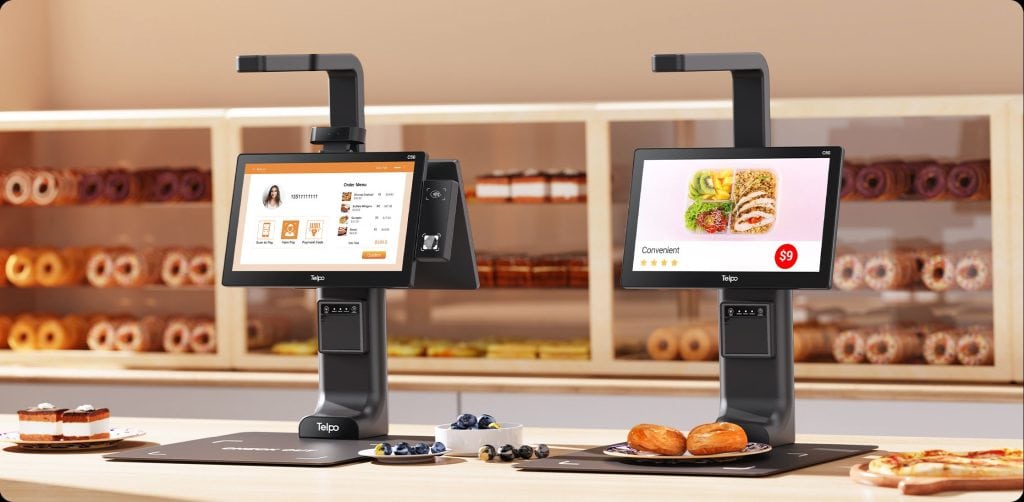
Telpo C50 AI Vision Checkout Terminal
Which Telpo Terminals Fit Smart Dining Projects?
Telpo TPS652 — AI Recognition Weighing Settlement Terminal (ODM) 2MP facial recognition camera; 5MP self-developed high-angle AI camera; integrated scale module (30 kg / 10 g) — POS weighing scale and self-checkout scale in one; AI dish/tray recognition with photographic evidence; LED fill light, dual-speaker voice prompts, 5-inch touchscreen; Android 11, SDK/API support. Ideal for: school canteens, institutional catering, subsidized meal programs.
Telpo C50 — AI Vision Checkout Terminal. AI camera with up to 99% recognition accuracy; dual AI cameras for dish capture at any distance; recognizes and prices meals without RFID chips; integrates “AI algorithms + weighing” for rapid self-checkout. Ideal for: corporate canteens, smart restaurant POS, self-service dining. Product page
Telpo Smart Canteen Solution an end-to-end smart canteen management system and digital dining package combining AI checkout, face payment, weighing, and data analytics — helping operators cut queues, reduce food waste, and manage procurement and menus with real consumption data.
FAQ
Q1: How does the ODM AI checkout machine verify each meal delivery?
Facial recognition identifies the student in under 3 seconds; the built-in scale records the portion weight in grams; a high-angle camera captures photographic evidence. Identity, weight, time, and location sync to the partner’s cloud platform — under 8 seconds per person in total.
Q2: Does the system store children’s facial photos?
No. The identification pipeline generates encrypted biometric templates instead of storing photographs, so images are never retained on the device. Deployment architecture can keep biometric data in-country under local regulation, with firmware-level adjustments for jurisdiction-specific privacy requirements.
Q3: What development support does Telpo provide for system integrators?
The TPS652 runs Android 11 and provides SDKs, APIs, and rich peripheral interfaces (Ethernet, USB, Micro-USB). Telpo’s engineering team supports partners from specification and prototyping through certification and mass production, with a CNAS-accredited laboratory validating camera, scale, and compliance requirements.
Q4: Can Telpo support program-scale deployment volumes?
Yes. Telpo operates an in-house production line with capacity for rapid ramp-up. Because this project involves full ODM customization — including a custom housing — lead times differ from standard products and depend on project scope and requirements. Contact Telpo sales for a project-specific proposal.
Q5: What measurable results did the deployment deliver?
Tens of thousands of verified deliveries were recorded during the pilot phase across multiple departments. Paper rosters were replaced by real-time auditable records, anomaly alerts shifted oversight from reactive to proactive, and family engagement rose once delivery notifications were introduced.
Bring Smart Dining to Your Region
Telpo works with software providers, system integrators, and program operators worldwide to deliver smart canteen solutions tailored to local regulations and operating conditions — including Latin America, where this deployment demonstrates production-proven readiness for public-sector and institutional dining projects.
Whether you need an ODM-customized weighing terminal like the TPS652, an AI checkout platform like the C50, or a complete self-checkout dining solution, Telpo’s regional teams can support you from pilot to national scale.
Contact Telpo today to discuss a tailored smart dining solution for your market.
About Telpo
Telpo (Telpo Technology Co., Ltd.) is a leading global provider of AI-driven smart terminals and solutions. Founded in 1999 on the mission to “Create a Colorful Future”, Telpo designs and manufactures smart terminal hardware with built-in connectivity, powering payment, retail, transportation, security, and digital identity applications in over 100 countries. Its 200+ engineer R&D team, 300+ patents, and CNAS-accredited lab uphold rigorous standards in design and compliance. Through deep ODM expertise and close collaboration with local partners, Telpo turns customer requirements into certified, deployment-ready terminals.