
Quick Insight
AI loss prevention self-checkout comes in two architectures: purpose-built terminals with integrated AI vision, and standard self-service kiosks with cameras added afterwards. When Meituan opened its first Xiaoxiang Supermarket in Beijing in December 2025, it chose the first — a custom Telpo K20P with AI loss-prevention cameras and a tri-colour alert pole. Deployments of this architecture have cut shrinkage by up to 85%. The two designs differ in ways a spec sheet will not show you.
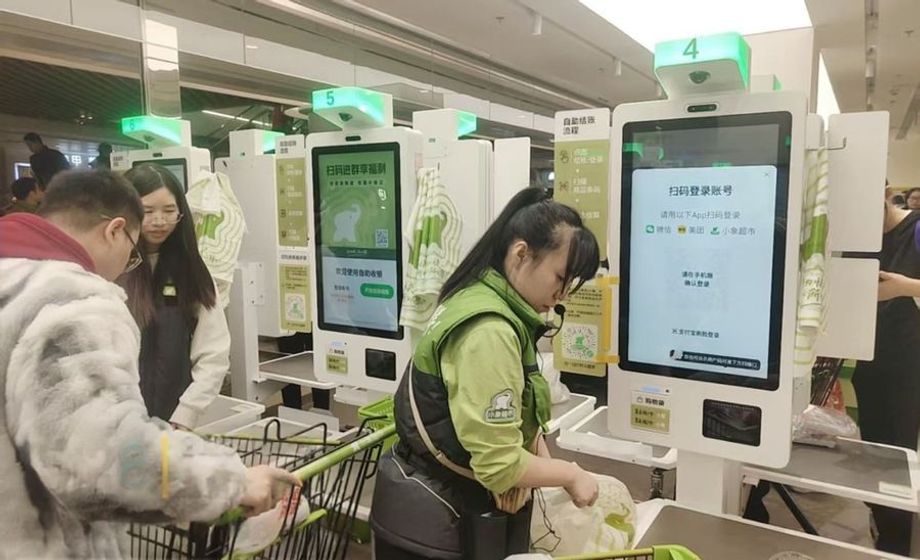
Table des Matières
-
AI Loss Prevention Self-Checkout Architecture: The K20P Reference Build
-
The Bottom Line: Purpose-Built Wins When Shrinkage Is the Problem
Case Background: Meituan’s Xiaoxiang Supermarket
On December 19, 2025, Meituan opened the first Xiaoxiang Supermarket store in Wanliu, Beijing — the offline extension of its instant-retail brand (rebranded from Meituan Maicai in December 2023). Foot traffic surged immediately, and with it came the defining problem of fresh-food retail: the peak-hour “Golden Hour,” when a store must move maximum volume without letting queues or losses eat the margin.
Xiaoxiang’s answer was a customized intelligent self-checkout: the Telpo K20P, an AI loss prevention self-service kiosk built with integrated indicator lights and AI-driven loss-prevention cameras. The deployment logic is worth studying for any high-shrinkage format:
-
Throughput density. One traditional counter space holds two to three kiosks, roughly doubling checkout capacity per square meter.
-
Loss prevention at the shelf edge. The AI cameras watch the scanning zone and flag unscanned or mismatched items in real time — the fresh-produce and liquor sections, where high-value shrinkage concentrates, get the closest surveillance.
-
Labor redeployment. Staff leave the register and move to value-added stations — the bakery runs 13 people on live baking, and “Wave Wizards” staff the aquatics section.
-
Ecosystem integration. Meituan Pay, WeChat Pay, and Alipay run natively, with one-click redemption of Meituan/Dianping vouchers and membership points.
-
Inventory linkage. Every scan updates real-time inventory and shopper-behavior data, feeding restocking and promotion decisions.
The full deployment story is in our Meituan Xiaoxiang Supermarket case coverage. The question this article answers: why did the architecture behind that deployment require purpose-built hardware, and when does a standard kiosk still make sense?
The Shrinkage Problem Self-Checkout Created
Self-checkout shrinkage costs retailers 2–3% of items industry-wide. For a mid-sized supermarket running ten terminals, that translates to tens of thousands of dollars in daily losses. The concept itself works — labor drops, queues shorten. The gap sits in what the machines replaced: a cashier’s eyes.
Retailers traded oversight for efficiency, and organized fraud, accidental mis-scans, and tag-switching moved into the monitoring void. Shrinkage at self-checkout lanes routinely exceeds the store average everywhere else on the floor — the gap an AI loss prevention self-checkout is built to close. The global self-checkout hardware market is projected to reach $2.715 billion by 2032 (QYResearch), and every major format — warehouse clubs, fresh-food chains, convenience stores — is re-evaluating its checkout strategy under this pressure.
Why Standard Kiosks Cannot Solve Shrinkage
A standard self-service kiosk — the type deployed for ordering, payment, and check-in — was never designed to watch customer behavior at the scanning zone. Standard kiosks lack full-area scanning-zone monitoring, real-time anomaly detection, and terminal-level alerts; weight scales detect discrepancies only after bagging and cannot separate accidental mis-scans from deliberate fraud. An AI loss prevention self-checkout starts from the opposite direction: the cameras, the model, and the alert live in the same housing as the scanner.
Full-area vision coverage. Standard kiosks carry generic cameras positioned for face recognition or QR scanning. They see faces and codes; they do not see the entire scanning zone from above, which is where missed scans and item swaps actually happen.
Real-time anomaly detection. Weight-based security scales report discrepancies after the fact. By the time a weight mismatch triggers, the item is already bagged.
Integrated alert proximity. Bolt-on security cameras push alerts to a back-office monitor, inserting a delay between the event and any staff response. Effective intervention needs immediate visual feedback at the terminal, visible to both the customer and nearby staff.
|
Capacité |
Standard Kiosk |
Purpose-Built AI Terminal |
|---|---|---|
|
Scanning zone monitoring |
Non |
Full-area camera coverage |
|
Real-time anomaly detection |
Weight scales only |
AI model on edge |
|
Visual alert at terminal |
Back-office monitor |
Integrated tri-color alert light |
|
Fraud type distinction |
Cannot distinguish |
Missed / wrong scan / tag fraud |
|
Modular field repair |
Variable |
Hot-swappable core components |
AI Loss Prevention Self-Checkout Architecture: The K20P Reference Build
An AI loss prevention self-checkout is a self-service terminal that pairs scanning and payment with computer vision trained on the scanning zone, flagging missed scans, item swaps, and tag fraud before the customer walks away. The K20P that Xiaoxiang runs belongs to Telpo’s K20 self-checkout family, and it illustrates what that architecture looks like when it is designed in from the start. The public reference specification — verified against our production data — looks like this:
|
Component |
K20 Reference Specification |
|---|---|
|
Compute |
Octa-core 2.4 GHz, 8 GB RAM / 64 GB ROM, Telpo OS (Android 12) |
|
Affichage |
27-inch HD touchscreen, 1080 × 1920 |
|
Imprimante |
80 mm thermal printer, auto cutter, 150–200 mm/s (max 220 mm/s) |
|
Scanning |
Integrated 1D/2D barcode scanner |
|
Vision |
3D depth-sensing camera option; binocular AI cameras on the K20P build |
|
Paiement |
ISO14443 contactless (NFC), QR scanning via camera |
|
Certifications |
CE; regional schemes per project |
Numbers alone miss the point. Three design decisions are doing the loss-prevention work:
Vision verification at the point of scan. The AI model compares what the scanner registers against what the camera sees. When a barcode enters the system, the model checks the item’s visual signature against that registration — catching the item passed through without a scan, the cheap barcode on the expensive item, and the mis-scan that weight scales would log as a discrepancy minutes later.
The tri-color alert pole. Alerts happen where they can change behavior: at the terminal. Green keeps the flow moving; the alert states turn the pole into a visible signal for both the customer and the nearest staff member — no back-office monitor, no delay.
Algorithm-to-hardware co-design. The camera angle, lighting, and processing budget are engineered into the housing. That is why effective deployments are ODM projects rather than firmware tweaks on generic hardware, and why the Telpo AI vision checkout terminal line is built around the same principle.
Verified Results: 85% Shrinkage Reduction
Live deployments of this AI loss prevention self-checkout architecture at major retail operators — a fresh-food supermarket chain with 1,000+ stores and a major online grocer’s dark-store format across 39 cities and 2,000+ warehouses — produced the following measured results:
|
Métrique |
Result |
Source |
|---|---|---|
|
Shrinkage reduction |
85% drop in theft/shrinkage rate |
Dark-store deployment data |
|
Daily loss recovery |
¥400+ per store per day |
Dark-store deployment data |
|
Dispute rate reduction |
70% fewer customer disputes |
Dark-store deployment data |
|
Queue time reduction |
36% shorter waiting time |
Supermarket chain data |
|
Labor efficiency |
4x improvement (1 staff : 4 terminals) |
Supermarket chain data |
|
Labor cost reduction |
50%+ less manpower needed |
Supermarket chain data |
|
Alert accuracy |
90%+ precision in anomaly detection |
Internal validation |
Two honest notes on scope. The 85% figure comes from the dark-store deployment, where terminals run as unattended kiosk operations and the AI system — rather than any person — is the first line of defense; it should not be read as a guaranteed result for every store format. The Xiaoxiang deployment, meanwhile, demonstrates the architecture at production scale with a named operator, though Meituan has not published shrinkage figures for that rollout. The 70% dispute reduction matters almost as much as the shrinkage number: fewer confrontations means lower staff turnover and a better customer experience.
Selection Framework, Cost, and Supplier Checks
Retailers evaluating an AI loss prevention self-checkout purchase should answer one question before comparing spec sheets: is shrinkage the primary pain point, or is the goal general automation?
What drives self-checkout kiosk cost
Pricing is quoted per project. Purpose-built AI terminals carry ODM engineering and typically require 500–1,000 units MOQ with 8–15 week lead times after a technical feasibility review; sample orders are available for pilot validation before fleet-scale commitment. Standard units listed as self-checkout kiosks for sale carry lower MOQ and faster delivery, which suits operators who need general automation rather than loss prevention. Fleet volume, certification scope, and customization depth drive the final self-checkout kiosk cost.
Matching hardware to store format
Grocery store self-checkout machines face a harder recognition problem than fixed-SKU formats: fresh produce carries variable weight and visual signatures, which is exactly where visual AI adds value over weight scales alone. A supermarket self-checkout machine deployment at chain scale also generates the transaction volume that justifies AI vision hardware; a self-checkout machine supermarket pilot in the low hundreds of daily transactions rarely does.
Vetting self-checkout kiosk manufacturers
The supplier list for this hardware looks similar on paper. The differences show up in four checks: deployment references with measured shrinkage data (not demo videos), ODM engineering depth, regional certifications (CE, FCC, PCI-PTS), and fleet-management tooling including OTA updates and remote device control. With self-checkout kiosk manufacturers, treat a documented deployment reference as the single strongest signal.
|
Decision Factor |
Purpose-Built Custom Terminal |
Standard Kiosk |
|---|---|---|
|
Primary pain point |
Shrinkage / loss prevention |
Labor cost / queue reduction |
|
AI vision required |
Yes — integrated cameras + AI model |
No — optional barcode/face only |
|
Daily self-checkout volume |
>2,000 transactions |
Variable |
|
Hardware footprint |
Counter-optimized, 2–3 units per lane space |
Flexible (desk, floor, wall, counter) |
|
NRE / lead time |
8–15 weeks, feasibility review |
Standard stock, shorter lead time |
|
MOQ threshold |
500–1,000 units for ODM |
Lower MOQ, sample orders accepted |
|
Typical retail format |
Supermarket, fresh food, warehouse club |
Retail, QSR, healthcare, banking |
Rule of thumb: if shrinkage is eating your self-checkout margins and you need real-time anomaly detection, a purpose-built custom terminal is the viable path. If the goal is general self-service automation — ordering, payment, check-in — a standard kiosk deploys faster and cheaper. (Both categories live in the self-service kiosk family; the terminology — self checkout kiosk, self service checkout kiosk, supermarket self checkout machine — overlaps heavily across suppliers.)
Frequently Asked Questions (FAQ)
Q1. What is an AI loss prevention self-checkout?
An AI loss prevention self-checkout is a self-service terminal that pairs scanning and payment with computer vision trained on the scanning zone, flagging missed scans, item swaps, and tag fraud before the customer walks away.
Q2. Why can’t a standard self-checkout kiosk prevent shrinkage?
Standard kiosks lack full-area scanning-zone monitoring, real-time anomaly detection, and terminal-level alerts; weight scales detect discrepancies only after bagging and cannot separate accidental mis-scans from deliberate fraud.
Q3. How much does an AI loss prevention self-checkout cost?
Pricing is quoted per project. Purpose-built AI terminals carry ODM engineering and typically require 500–1,000 units MOQ with 8–15 week lead times after a technical feasibility review; sample orders are available for pilot validation before fleet-scale commitment.
Q4. Is the 85% shrinkage reduction guaranteed for every store format?
The 85% figure comes from the dark-store deployment, where terminals run as unattended kiosk operations and the AI system — rather than any person — is the first line of defense; it should not be read as a guaranteed result for every store format.
The Bottom Line: Purpose-Built Wins When Shrinkage Is the Problem
Un AI loss prevention self-checkout requires purpose-built hardware, with 85% shrinkage reduction verified at live retail scale. The strongest terminals are custom ODM projects with algorithm-to-hardware co-design; their vision systems, modularity, and alert proximity are engineered for specific shrinkage profiles, not retrofitted. High-volume fresh-food formats benefit most: grocery store self-checkout machines handle produce with variable visual signatures, and supermarket self-checkout machine deployments at chain scale justify AI vision hardware. Named deployments such as Meituan’s Xiaoxiang Supermarket show the architecture running production peak-hour volume; the dark-store data shows what it does to shrinkage when the system is the first line of defense. Standard kiosks cover general self-service workflows across retail, QSR, healthcare, and institutional markets without custom NRE — and they will not solve self-checkout shrinkage. ODM customization typically requires a 500–1,000 units MOQ and 8–15 week lead times; sample orders allow pilot validation before fleet commitment.
Tell us your store count, shrinkage baseline, and target market at [email protected], and Telpo will map the AI loss prevention self-checkout configuration — sample units are available for pilot validation. For custom builds, start with the custom self-checkout ODM program; for standard units, see the 27-inch kiosk machine reference build, the broader self-service kiosk line, or the full kiosk machine range across form factors.
Related Reading
-
How Meituan’s Xiaoxiang Supermarket runs self-checkout — the named deployment behind this article’s opening
-
AI checkout machine overview — where AI self-checkout fits in the broader hardware landscape
-
Bakery self-checkout case: AI food recognition — visual recognition applied to fresh categories
À propos de Telpo: Telpo (Telpo Technology Co., Ltd.) is a leading global provider of AI-driven smart terminals and solutions. Founded in 1999 on the mission to Create a Colorful Future, Telpo designs and manufactures smart terminal hardware with built-in connectivity, powering payment, retail, transportation, security, and digital identity applications worldwide. Headquartered in China with branches in Hong Kong, Nigeria, and the U.S., Telpo serves customers across more than 100 countries. Its 200+ engineer R&D team, backed by 300+ patents and a CNAS-accredited lab, uphold rigorous standards in design, testing, reliability, and compliance. Long-term partnerships with MTN, Vodafone, Burger King, 7-Eleven, Alipay, and Bank of China reflect its proven track record. Driven by deep ODM expertise, Telpo works closely with customers and local partners — from concept to certification and manufacturing — delivering hardware built to exact configurations, turning customer requirements into deployment-ready terminals.