
The Nilson Report, the most respected publication covering the global payment card industry, featured Telpo P9 POS Terminal in its August 2026 issue — a recognition that puts the P9 in front of payment industry decision-makers across 80+ countries who rely on the publication for hardware intelligence and vendor evaluation.
Here is what the article covers, and what it means for operators evaluating their next handheld eftpos machine.
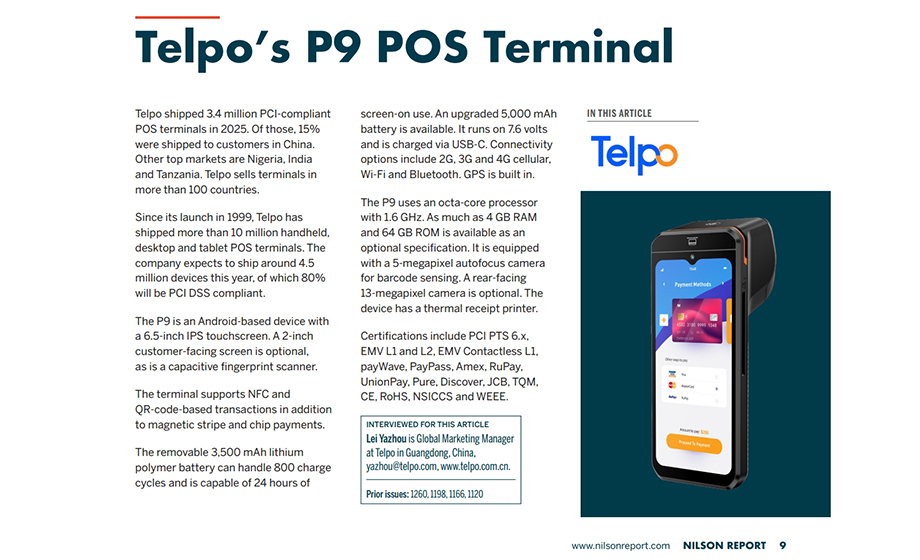
What the Nilson Report Says About Telpo and the P9
According to the Nilson Report’s August 2026 issue, Telpo shipped 3.4 million PCI-compliant POS terminals in 2025, selling across more than 100 countries with Nigeria, India, and Tanzania among its top markets outside China. Since its launch in 1999, Telpo has shipped more than 10 million handheld, desktop, and tablet POS terminals and expects to ship around 4.5 million devices this year, of which 80% will be PCI DSS compliant.
On the P9 itself, the Nilson Report records the following specifications:
-
6.5-inch IPS touchscreen, with an optional 2-inch customer-facing screen and optional capacitive fingerprint scanner
-
NFC and QR code-based transactions alongside magnetic stripe and chip payments
-
Removable 3,500mAh lithium polymer battery rated for 800 charge cycles and 24 hours of screen-on use, with an optional 5,000mAh upgrade
-
Octa-core processor at 1.6GHz, up to 4GB RAM and 64GB ROM
-
5MP autofocus front camera for barcode sensing, optional 13MP rear camera, and integrated thermal receipt printer
-
Connectivity: 2G, 3G, 4G cellular, Wi-Fi, Bluetooth, and built-in GPS
-
Certifications: PCI PTS 6.x, EMV L1 and L2, EMV Contactless L1, Paywave, PayPass, Amex, RuPay, UnionPay, Pure, Discover, JCB, TQM, CE, RoHS, NSICCS, and WEEE
The breadth of that certification list is notable — it covers the major international card schemes, regional networks across Asia and South Asia, and environmental compliance standards, making the P9 one of the most broadly certified Android eftpos terminals currently available in the handheld segment.
The Telpo P9 as a New Generation Mobile POS Terminal
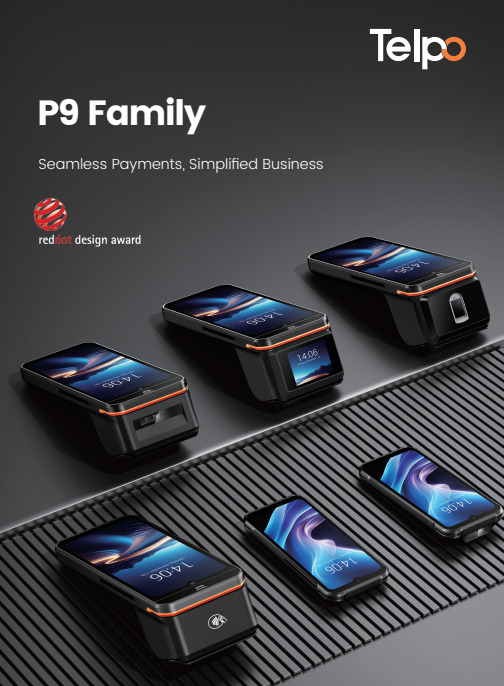
The Telpo P9 is an Android eftpos terminal with an integrated printer designed for merchants, banking agents, and field operators who need full payment capability — NFC, QR code, magnetic stripe, chip, and receipt printing — in a single certified handheld device.
The Telpo P9 is built around a single operating premise: merchants, banking agents, and field operators should not have to choose between mobility and capability. Every payment method, receipt printing, extended battery life, and certification compliance — in one pos portable machine that goes where the business is.
Where previous handheld terminals forced operators to carry supplementary hardware or return to a fixed counter for certain transaction types, the P9 consolidates payment acceptance, printing, and optional biometric or scanning capability into a single android based pos machine that handles a full commercial shift without interruption.
Where Traditional Terminals Fall Short — and How the P9 Responds
Most conventional handheld payment terminals were optimized for card transaction speed alone — leaving dust ingress, mid-shift battery failure, and certification gaps as unresolved operational liabilities for retail, logistics, and field banking deployments.
| Pain Point | Traditional Payment Terminal | Telpo P9 |
| Dust in printer compartment | Open paper exit allows dust to settle into mechanism, causing jams and wear | Side dust cover and downward paper exit block dust ingress, extending printer lifespan |
| Battery life mid-shift | Fixed non-removable battery, often requiring charging during peak hours | 3,500mAh removable battery rated for 24 hours screen-on; 5,000mAh upgrade available |
| Downtime for charging | Device must be taken out of service during charge cycle | Hot-swap removable battery — zero downtime between shifts |
| Payment method gaps | Card-only or lacking QR and digital wallet support | NFC, QR code, magnetic stripe, chip, and multi-scheme digital wallet acceptance |
| Receipt printing requires secondary hardware | Many handhelds lack an integrated printer | Built-in thermal printer — no secondary device needed at point of transaction |
| Limited regional certification coverage | Often covers only Visa and Mastercard schemes | 17 certifications including RuPay, UnionPay, Amex, Discover, NSICCS, and WEEE |
| Fixed single configuration | One hardware spec regardless of use case | Optional customer display, fingerprint scanner, and 13MP rear camera |
| Battery degradation over time | Non-removable batteries degrade and cannot be replaced without service | 800-cycle rated removable battery — replaceable in the field, not at a service center |
The dust protection design is particularly relevant for food service, outdoor retail, and logistics environments where standard printer compartments accumulate debris during normal operation. The side dust cover combined with downward paper exit means particles fall away from the mechanism rather than into it — a structural detail with direct impact on print reliability and maintenance frequency over a multi-year deployment.
The 800-cycle battery rating covers roughly two years of daily full-charge cycles before degradation begins. Because the battery is removable, replacement is a field operation — no service center visit, no device downtime, no gap in coverage for the operator. For operators specifically looking for a new pos terminal with removable battery and integrated printer, the P9 addresses both requirements in a single certified device.
A Certification Stack Built for Global Deployment
The P9 carries 17 certifications — including PCI PTS 6.x, EMV L1 and L2, RuPay, UnionPay, NSICCS, and WEEE — making it a pos portable machine that qualifies for deployment across regulated payment environments in Europe, Asia, South Asia, and Africa without market-by-market recertification.
PCI PTS 6.x and EMV L1/L2 cover the international baseline. Paywave and PayPass cover Visa and Mastercard contactless. RuPay covers India. UnionPay covers China and markets where UnionPay acceptance is required. NSICCS covers Indonesia’s national chip card standard. CE, RoHS, and WEEE cover European regulatory and environmental requirements.
For system integrators managing multi-country rollouts, a single hardware platform carrying this certification breadth eliminates the procurement complexity of sourcing different certified devices for different markets — the P9 qualifies as a mobile pos terminal with printer for banking agents and retail operators across all of these environments on the same hardware SKU.
FAQ
Q1: Telpo expects 80% of its 2026 shipments to be PCI DSS compliant terminals — what does this say about the company’s product direction?
It reflects a deliberate shift toward security-certified hardware as the default across Telpo’s export product line. PCI DSS compliance is a baseline requirement for terminals entering regulated payment markets globally — and shipping 80% of 4.5 million projected devices to that standard signals that Telpo’s core volume is increasingly oriented toward markets and clients where certification is a procurement prerequisite, not an optional feature.
Q2: How does the P9’s removable 3,500mAh battery with an 800-cycle rating translate into practical fleet management?
The 800-cycle rating covers roughly two years of daily charging before capacity degrades — at which point the battery is swapped in the field, not the device sent for service. For banking agent programs or multi-location retail fleets where service logistics are costly, this keeps devices in operation longer and reduces the per-device replacement cost over a standard deployment cycle.
Q3: The P9 carries certifications for RuPay, UnionPay, NSICCS, and Discover alongside the standard Visa and Mastercard stack. When does this breadth matter?
It matters when deployments cross regional payment ecosystem boundaries. India requires RuPay, Indonesia requires NSICCS, and markets with significant Chinese outbound tourism need UnionPay. A single P9 configuration covering all of these eliminates the need to source and manage separate certified SKUs per market — a procurement and integration efficiency that compounds significantly across multi-country rollouts.