
The most expensive part of a fare collection terminal rollout is rarely the terminal. It is the bus pulled from service for a retrofit, the technician dispatched to a depot three hours away, the fare revenue that stops the day a validator goes dark. Across bus operator projects Telpo has supported — a rollout heading past 2,000 buses in Germany, reverse-QR fleets in the Americas, T20 validators checking tickets in Italian cities — one pattern repeats: deployments are won or lost before installation day, at the specification and planning stage.
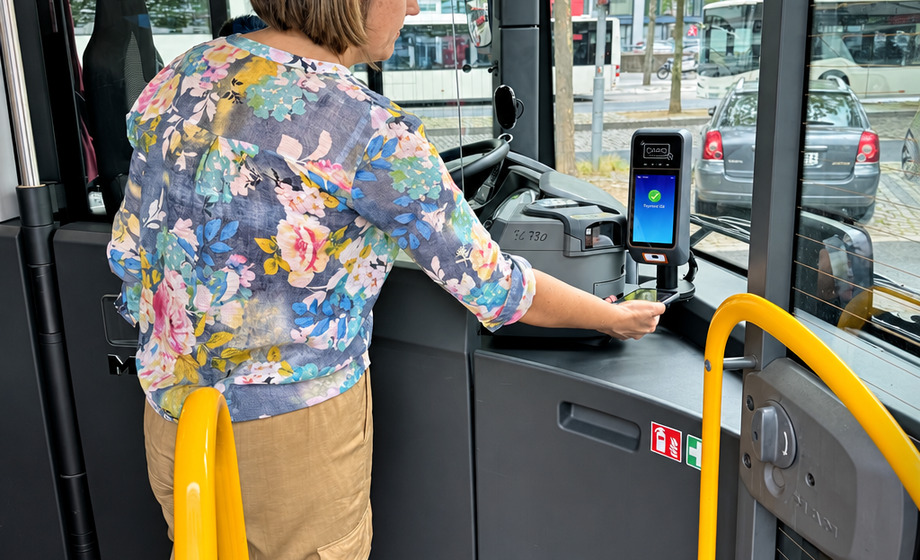
This guide compresses that experience into six checks, each with a pass line you can hold against any spec sheet. Run them in order, and most field failures become preventable.
In this guide:
- What an on-board validator has to do
- Q1: Will it survive the vehicle?
- Q2: Will it work with our tickets and our bus?
- Q3: Can we run a fleet of them?
- The six checks at a glance
- Lessons from bus operator projects
- One boundary, stated early
- FAQ
- The bottom line
What an on-board validator actually has to do
Skip the marketing definitions. A bus validator has four jobs, and every datasheet line that matters serves one of them:
-
Read every medium passengers present — transit cards, bank cards, app barcodes, paper QR codes.
-
Stay connected — and keep working when it isn’t.
-
Talk to the vehicle it is mounted in.
-
Run for years without a technician standing beside it.
If a spec does not serve one of these four jobs, it is not a decision factor. The checks follow.
Question 1: Will it survive the vehicle?
Check 1 — Match the power bus. Bus electrics run nominally at 12V or 24V and spike far outside that band at engine crank. A narrow input range means reboots at the worst moment, mid-fare. The pass line: a DC 9–40V input range, which both the Telpo T10 et Telpo T20 accept, plus a key switch so drivers can cut power without an electrician.
Check 2 — Specify the environment, not the model. Vibration at every stop, rain blown through open doors, summer cabins past 50°C. Ratings decide whether a unit survives year three, not whether it powers on in the lab. The pass line: IK07 or IK08 impact resistance, IP54 or IP65 sealing by mounting position, an operating range of -20°C to +60°C, and the E24 vehicle-approval mark. Rail deployments add EN 45545 fire compliance.
Question 2: Will it work with our tickets and our bus?
Check 3 — Plan media before models. A modern bus may need closed-loop transit cards (ISO14443 Type A/B, Mifare), open-loop bank taps (EMV sans contact L1 with Paywave and Paypass, as an option), and app or paper barcodes through a hard-decoding 1D/2D scanner. The pass line: the right reader set plus SAM headroom — six SAM slots on the T10, up to eight on the T20. SAM count, not screen size, decides how many schemes and operators one device can serve.
Check 4 — Plan connectivity for a moving vehicle. Shops have stable WiFi. Buses cross coverage gaps, tunnels, and sometimes borders. Cloud validation dies with the signal unless transactions can buffer. The pass line: dual SIM slots or eSIM on the T10, an external GNSS/LTE antenna option for metallized windows, built-in GPS for fleet visibility, and storage headroom — TF expansion to 256GB — to queue transactions through long offline stretches.
Check 5 — Map the vehicle-bus integration before mounting. A validator is one node in the bus’s machine network: destination boards, door signals, sometimes the farebox. Discovering an incompatible interface after mounting means drilling new holes. The pass line: RS232, RS485, and CAN on the T20, relay and four GPIO ports on both units, plus SDK documentation requested early — interfaces documented late get redesigned late.
Question 3: Can we run a fleet of them?
Check 6 — Design for a fleet you will never visit. At hundreds of buses, a configuration change cannot require a depot visit. The pass line: Telpo MDM that locks, updates, and monitors devices remotely; LED indicators and voice prompts a driver can read without looking away from the road; and storage headroom for long offline stretches.
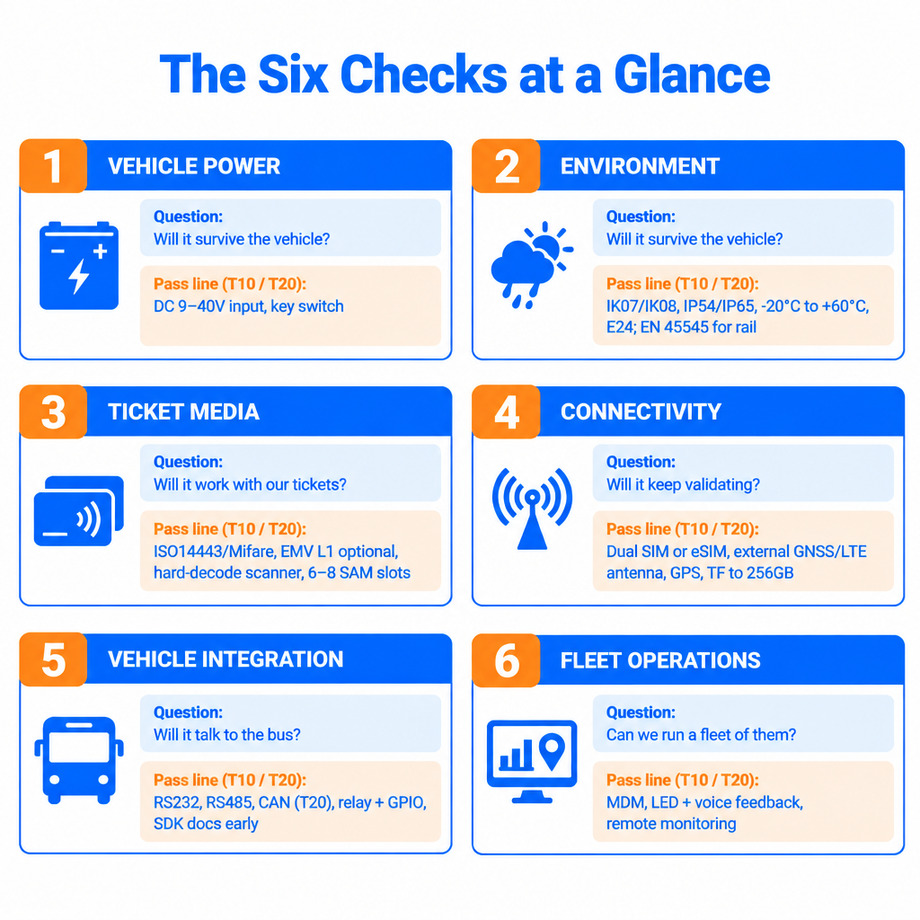
The six checks at a glance
|
|
Check |
Question it answers |
Pass line (T10 / T20) |
|---|---|---|---|
|
1 |
Vehicle power |
Will it survive the vehicle? |
DC 9–40V input, key switch |
|
2 |
Environment |
Will it survive the vehicle? |
IK07/IK08, IP54/IP65, -20°C to +60°C, E24; EN 45545 for rail |
|
3 |
Ticket media |
Will it work with our tickets? |
ISO14443/Mifare, EMV L1 optional, hard-decode scanner, 6–8 SAM slots |
|
4 |
Connectivité |
Will it keep validating? |
Dual SIM or eSIM, external GNSS/LTE antenna, GPS, TF to 256GB |
|
5 |
Vehicle integration |
Will it talk to the bus? |
RS232, RS485, CAN (T20), relay + GPIO, SDK docs early |
|
6 |
Fleet operations |
Can we run a fleet of them? |
MDM, LED + voice feedback, remote monitoring |
Lessons from bus operator projects
The checks are not theory. Each one exists because a project proved it.
Germany — the D-Ticket rollout. Telpo T10 units run on German buses as on-board control devices, integrated with the D-Ticket application and backend through Telpo’s ticketing-software partner, in a rollout expected to pass 2,000 buses. Every check appears here: media bought in apps (Check 3), value carried by backend integration (Check 5), and 2,000-unit economics resting on driver-readable feedback and remote management (Check 6). The operator-side data — ticket usage, passenger counts by route and hour, the issuing company behind every inspected ticket — is what curbs fare evasion and tunes service.
The Latin Americas — Busae’s reverse QR. Validation logic moved to the cloud and the passenger’s phone. It works because the on-board terminal keeps scanning and stays connected (Checks 3 and 4) — even when the ticket scheme lives off the vehicle, the validator remains the last line of verification.
Italy —T20 validators. QR ticketing sold through e-commerce means media purchased outside the vehicle — a Check 3 decision that would have stalled the project had it been made late.
Account-based ticketing. The tap is the simple part; the account behind it is the hard part. ABT turns the validator into the edge of an account system — a Check 5 architecture decision, not a hardware one.
Different countries, different schemes, same lesson: these projects succeed at integration time, not at payment time.
One boundary, stated early
Telpo builds validator hardware — the T10 and T20 — and provides the SDK, documented interfaces, and MDM platform that connect it to ticketing systems. Telpo does not provide the end-user ticketing software. Settle the software question before the pilot, not after it.
Scope note
Specifications above come from Telpo product documentation for the T10 and T20; configurations and certification sets vary by target market — ask for the list that applies to your project. Telpo has built ODM hardware since 1999, serves customers in more than 100 countries, and tests in its own CNAS-accredited laboratory.
Related reading from Telpo
- guide smart ticketing system
- fare collection equipment guide
- benefits deploying card readers metro ticket gates
- quality testing of the Telpo T20
FAQ
Q1. What DC input range should a bus fare collection terminal accept?
Bus electrics run nominally at 12V or 24V and spike far outside that band at engine crank. A narrow input range means reboots at the worst moment, mid-fare. The pass line: a DC 9–40V input range, which both the Telpo T10 and T20 accept, plus a key switch so drivers can cut power without an electrician.
Q2. How many ticketing schemes can one on-board validator serve?
SAM count, not screen size, decides how many schemes and operators one device can serve. The pass line: six SAM slots on the T10, up to eight on the T20, plus the reader set that matches your media mix.
Q3. Can a validator keep validating when the bus loses connectivity?
Cloud validation dies with the signal unless transactions can buffer. The pass line: dual SIM slots or eSIM, an external GNSS/LTE antenna option for metallized windows, built-in GPS, and TF expansion to 256GB to queue transactions through long offline stretches.
Q4. Does Telpo provide the end-user ticketing software?
Telpo builds validator hardware — the T10 and T20 — and provides the SDK, documented interfaces, and MDM platform that connect it to ticketing systems. Telpo does not provide the end-user ticketing software. Settle the software question before the pilot, not after it.
The Bottom Line
Deployments are won or lost at the specification stage, not on installation day. Six checks cover the failure points Telpo sees in real bus operator projects: vehicle power, environment ratings, ticket media, connectivity, vehicle integration, and fleet operations. Run them in order against your routes, your tickets, and your fleet. Then tell us your route count, your ticket media, and your target market — Telpo will show you which unit passes all six. Samples and SDK documentation are available for evaluation: [email protected].
À propos de Telpo
Telpo (Telpo Technology Co., Ltd.) is a leading global provider of AI-driven smart terminals and solutions. Founded in 1999 on the mission to create a colourful future, Telpo designs and manufactures smart terminal hardware with built-in connectivity, powering payment, retail, transportation, security, and digital identity applications worldwide. Headquartered in China with branches in Hong Kong, Nigeria, and the U.S., Telpo serves customers across more than 100 countries. Its R&D team of 200+ engineers, backed by 300+ patents and a CNAS-accredited lab, upholds rigorous standards for design, testing, reliability, and compliance. Long-term partnerships with MTN, Vodafone, Burger King, 7-Eleven, Alipay, and Bank of China reflect its proven track record. With deep ODM expertise, Telpo works closely with customers and local partners—from concept to certification and manufacturing—delivering hardware built to exact specifications and turning customer requirements into deployment-ready terminals.