
Choosing a fiscal POS supplier is not like choosing ordinary retail hardware. The device you buy today must still record transactions, pass inspections and remain repairable years from now — under regulations that keep evolving. This guide compares leading fiscal device manufacturers honestly: what each is good at, where each fits best, and what buyers should check before signing anything.
What Makes a Fiscal POS Supplier Worth Shortlisting?
In the fiscal world, boring is a feature. The best POS device is the one nobody notices for ten years. But stability is often confused with seniority — and they are not the same thing. A reliable fiscal POS supplier is not necessarily the one with the oldest brochure; it is the one whose supply chain you can predict for the next five years. On that basis, five criteria matter more than brand fame:
- Compliance record: devices deployed and accepted under real fiscal regimes, not just demo units.
- Device range: mobile, desktop and printing options that match your scenarios.
- Lifecycle and chip supply: a written commitment that core components will remain available for years.
- Openness: SDK and integration support, because fiscal hardware must talk to tax software.
- Fleet operations: remote management for hundreds or thousands of deployed units.
The Established Fiscal Device Specialists
ACLAS — the veteran with the full traditional line
ACLAS has been in the fiscal device business since the 1990s and positions itself as one of the largest fiscal device manufacturers in the Greater China area. Its catalogue covers fiscal cash registers, fiscal printers, fiscal boxes and fiscal POS terminals, with projects delivered across Europe, Africa, Latin America and Asia. For buyers who want a traditional, full-line supplier with decades of fiscal project references, ACLAS is the natural first call.
There is also a structural reason to take this camp seriously. The fiscal printer is quietly becoming software: Kenya’s eTIMS and Zambia’s Smart Invoice both move the receipt toward the cloud. As that happens, the hardware’s value concentrates in its security anchors — the secure modules, clocks and tamper-proofing described above — which is exactly where Android fiscal POS manufacturers have invested. For projects evaluating an Android fiscal POS for the first time, the checklist below applies unchanged.
Fiscat focuses on fiscal printers, fiscal ECRs and fiscal signature devices, building customized fiscal hardware for different countries’ regulations — and it has added Android POS systems to its range. For printer-centric projects that need country-specific customization, Fiscat is a proven, focused option.
Posnet is one of Poland’s best-known fiscal device manufacturers. Its core advantage is deep knowledge of local and EU fiscal certification, built over years of serving the Polish market. For deployments in Poland and neighbouring EU countries, few top fiscal POS suppliers in Europe understand the regulatory ground better.
A Modern E-Fiscal Device Solution: The Android Camp (Telpo)
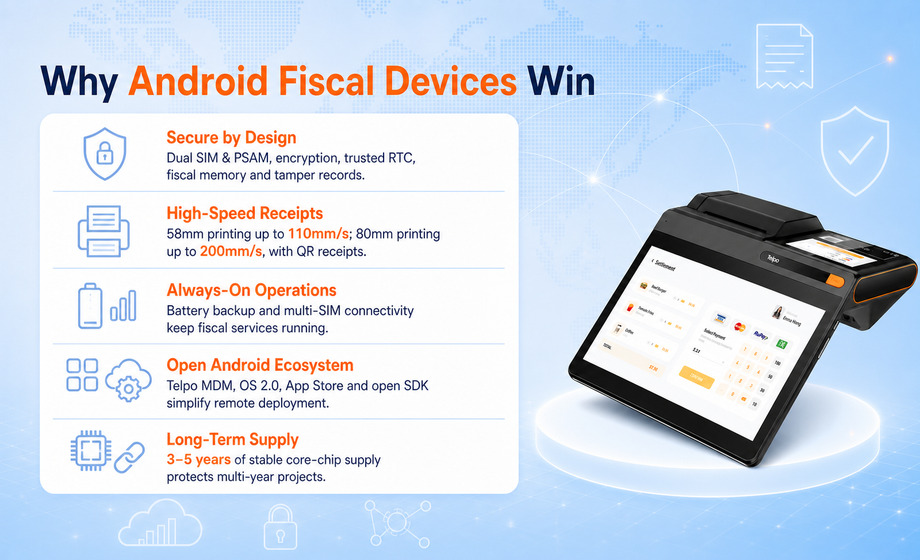
A newer group of fiscal POS terminal brands arrives from a different direction: smart payment terminals. Telpo, a China-based smart terminal manufacturer with more than two decades in the industry, builds Android fiscal POS devices for global tax compliance markets — and the pitch deserves attention precisely because fiscal buyers are conservative. Here is what the Android camp’s offering translates into for a risk-averse project:
- Compliance security anchors: 2 SIM and 2 PSAM slots for hardware-level encryption and authentication, OS-layer data signature and encryption, an external RTC circuit for trustworthy timestamps, dedicated fiscal memory for offline record-keeping, and lead seal screws with traceable dismantling records.
- Receipt performance: integrated thermal printing at up to 110mm/s on 58mm paper or up to 200mm/s on 80mm paper, with QR code receipts supported in the billing solution.
- Business continuity: battery backup on models such as the M8, and up to 4 SIM slots on mobile models like the TPS320 for multi-operator countries.
- Tax software integration: Telpo MDM, Telpo OS 2.0, the Telpo App Store and an open SDK, so local software partners can build, deploy and maintain the fiscal layer remotely.
- Supply assurance: a 3-5 year stable supply commitment for core module chips, protecting multi-year tenders from forced redesigns.
The credentials are already field-tested rather than theoretical: Telpo desktop POS hardware serves a retail shop in Europe, and its mobile terminals handle payment and fiscal management at a hotel in Central Asia. Models like the M8 smart EFD and the TPS900 mobile fiscal POS carry this design into production.
There is also a structural reason to take this camp seriously. The fiscal printer is quietly becoming software: Kenya’s eTIMS and Zambia’s Smart Invoice both move the receipt toward the cloud. As that happens, the hardware’s value concentrates in its security anchors — the secure modules, clocks and tamper-proofing described above — which is exactly where Android-based manufacturers have invested.
Head-to-Head: How the Two Groups Compare
|
Dimension |
Established Specialists (ACLAS, Fiscat, Posnet) |
Modern Android Fiscal POS (Telpo) |
|
Core solution |
Fiscal printers, ECRs, fiscal boxes |
Smart Android fiscal POS terminals |
|
Device range |
Traditional line, country-customized |
Mobile + desktop all-in-one devices |
|
Certification strength |
Deep in legacy regimes (EU, Turkey-style) |
EFD-style and software-centric markets |
|
Openness / SDK |
Limited |
Open SDK, Telpo OS 2.0, App Store |
|
Receipt printing |
Dedicated fiscal printers |
Integrated 58/80mm high-speed printing with QR |
|
Fleet operations |
Mostly manual maintenance |
Remote MDM at scale |
|
Supply assurance |
Varies by project |
Varies by project |
|
Best-fit projects |
Printer-centric, legacy replacement |
New rollouts, digitalization, integrator-led projects |
How to Choose: A Buyer’s Checklist
Whether your shortlist ends with a traditional specialist or a modern Android supplier, run every candidate through the same seven questions:
- Is the device accepted under your country’s current fiscal regime — and who maintains that certification?
- How many years is the chip supply guaranteed, in writing?
- Can your local software partner integrate via a documented SDK?
- Does receipt printing meet your legal format (including QR codes where required)?
- What happens to records during a power cut or a network outage?
- Can the fleet be updated and monitored remotely at scale?
- Who answers the phone after year three — the manufacturer or a reseller?
FAQ
Q: What is a fiscal device manufacturer?
A: A fiscal device manufacturer designs and produces hardware that records sales transactions in compliance with fiscalization laws — such as fiscal cash registers, fiscal printers and fiscal POS terminals — typically with tamper-proof mechanisms and secure data storage required by tax authorities.
Q: Which fiscal POS terminal brands are most recommended?
A: Among established specialists, ACLAS, Fiscat and Posnet are frequently shortlisted; among Android-based suppliers, Telpo is the representative name. The right choice depends on your country’s regime and your integration needs rather than on brand fame.
Q: Are Android POS devices suitable as fiscal devices?
A: In many EFD-style and software-centric regimes, yes — provided the device carries the required security anchors (secure modules, accurate clock, tamper evidence) and works with locally compliant fiscal software. In printer-centric regimes, dedicated fiscal printers remain the norm.
Q: What should a fiscal device tender specify?
A: Beyond basic specifications: chip supply duration, SDK documentation, printing speed and format, offline record-keeping, remote management capability, and post-warranty support terms.
Q: How important is tax software integration?
A: Decisive. A fiscal POS with tax software integration support lets your local partner own the compliance layer and adapt it as regulations change — without waiting for the hardware vendor.
Looking for a compliance-ready fiscal POS supplier for your market? Talk to the Telpo fiscal solution team about devices, SDK access and supply commitments for your project.