
Both devices are IP65-rated fingerprint biometric terminals built for serious field deployment. Both support multimodal biometric authentication. Both are engineered for government, enterprise, and security environments where hardware failure is not an acceptable outcome. So when procurement comes down to a 5.5-inch handheld versus an 8-inch tablet, the decision is not about which device is better — it is about which form factor fits the specific operational reality of the deployment. This article works through the key decision variables: scenario type, iris recognition requirements, screen size implications, environmental protection context, and a side-by-side specification comparison of the Telpo S5 and Telpo S9.
Table of Contents
Why the Biometrics Market Is Forcing a Hardware Decision
The biometrics market is growing fast enough that organizations can no longer defer the hardware decision — and the scale of investment makes getting that decision right the first time operationally and financially significant.
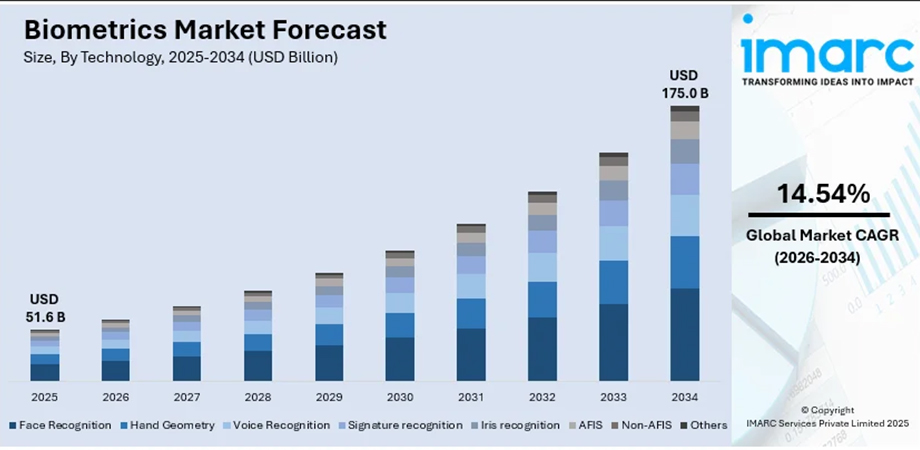
The global biometrics market was valued at USD 51.6 billion in 2025 and is projected to reach USD 175.0 billion by 2034, growing at a CAGR of 14.54%. This growth is being driven by government identity programs, border control modernization, financial institution authentication requirements, and enterprise access control deployments — all contexts where a biometric ID card machine or rugged biometric tablet is the field hardware that makes the system work. IMARC
Asia Pacific currently holds over 35.6% of the global biometrics market share, and governments across Africa, Latin America, and the Middle East are actively building biometric identity infrastructure for national ID programs, voter registration, and social welfare delivery. For system integrators and procurement teams serving these programs, the hardware selection — handheld fingerprint terminal or tablet-based enrollment station — determines operational efficiency, staff ergonomics, and total deployment cost across the program lifecycle. MarketsandMarkets
Scenario Determines Form Factor: Mobile Verification vs. Fixed Enrollment
The most reliable way to select between a handheld fingerprint terminal and a biometric tablet is to define the primary operational scenario first — because the two form factors are optimized for fundamentally different workflow types.
A handheld device is built for staff who move. Border patrol officers verifying identities in the field, election officials processing voter registration at community locations, law enforcement conducting mobile identity checks, and field agents onboarding new financial service customers in remote areas — all of these scenarios require a device that goes where the operator goes, operates without external power, and can be used one-handed while the operator manages the interaction. The Telpo S5, as an industrial biometric fingerprint reader in a 5.5-inch handheld form factor, is the device for these deployments.
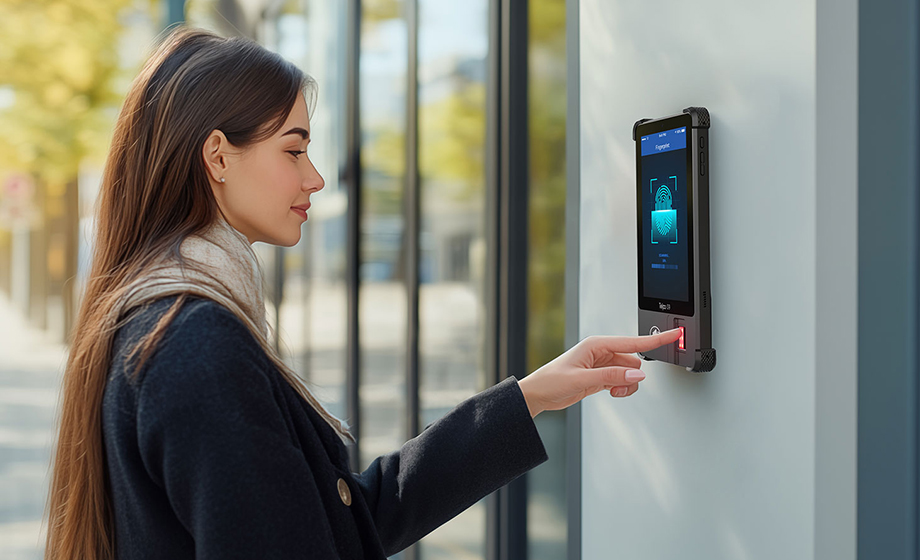
A tablet is built for staff who are stationary with the person being processed. Government service counters, enterprise access control stations, bank KYC enrollment desks, and examination center identity verification points — these scenarios benefit from a larger screen that guides the subject through the enrollment process, supports staff in reviewing and confirming captured data, and can be wall-mounted or turnstile-integrated for semi-permanent installation. The Telpo S9, as a rugged android tablet with an 8-inch display, is the device for these deployments.
The operational question to ask before hardware selection: does the operator go to the subject, or does the subject come to the operator? The answer determines the form factor.
Where Iris Recognition Handheld Device Becomes a Deployment Requirement
Iris recognition is not a universal requirement — but for specific deployment contexts, it is the only biometric modality that delivers the required accuracy and hygiene profile, making the presence or absence of iris capability a decisive hardware selection criterion.
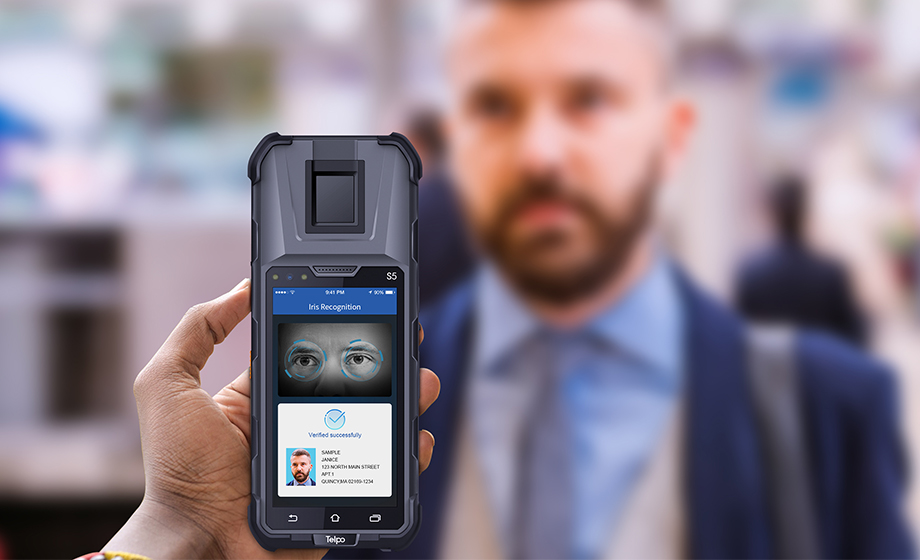
Iris recognition provides two advantages over fingerprint-only authentication that matter in specific scenarios. First, it is contactless — no physical touch required — making it the preferred modality for high-volume public environments where hygiene is a concern and throughput speed matters. Second, iris patterns are highly stable and difficult to alter, making iris recognition the appropriate modality for high-security identity verification where the consequences of false acceptance are significant.
The deployment contexts where iris recognition justifies its inclusion: border control and immigration processing where passport-linked biometric records include iris data; prison and corrections facilities where contact-based authentication creates security risks; healthcare environments where infection control protocols preclude touch-based verification; and government identity programs in markets where iris enrollment is part of the national biometric standard.
The Telpo S5 supports optional iris recognition as part of its multimodal configuration — meaning the same fingerprint biometric machine can be equipped for iris capture when the deployment context requires it, without switching to a different base device. For deployments that do not require iris recognition, the optional configuration keeps the base device cost appropriate to the actual requirement.
How Screen Size Shapes the Operational Workflow in Biometric Device
Screen size is not a cosmetic specification — it directly determines whether the device can effectively guide a subject through a multi-step enrollment process or is better suited to rapid, single-step verification in the field.
An 8-inch display gives the operator and subject enough screen real estate to review captured biometric data, confirm document scans, display enrollment progress across multiple steps, and present instructions in a format that a subject unfamiliar with the process can follow independently. For KYC enrollment, voter registration, and government service access — where the workflow involves multiple captures, confirmations, and data entry steps — the mobile biometric tablet S9’s display is operationally meaningful, not just more comfortable to look at.
A 5.5-inch display is optimized for single-step verification: the operator presents the device, the subject provides the biometric, the device confirms or denies. In mobile enforcement, event security, field identity checking, and on-site workforce attendance verification, the interaction is typically two to four seconds — and a larger screen adds weight and reduces one-handed operability without improving the outcome. The S5’s 5.5-inch form factor is precisely calibrated for this transaction type.
The secondary consideration is operator fatigue. A staff member conducting hundreds of verifications across a field shift carries the device continuously. The S5’s handheld form factor and 10,000mAh battery (discussed below) are designed for sustained one-handed use across a full operational day. The S9’s wall-mount and turnstile integration options mean the device stays in place — the subject comes to the device, and the operator monitors rather than carries.
Both the S5 biometric ID card machine and the S9 rugged biometric tablet carry IP65 certification — but the operational significance of that rating differs depending on whether the device is deployed in outdoor field conditions or in controlled indoor environments where the threat profile is different.
IP65 certifies complete dust ingress protection and resistance to water jets from any direction. For outdoor field deployments — election registration in rural areas, mobile border patrol, utility field services, outdoor event security — this means the S5 operates reliably in rain, dust, and the full range of uncontrolled environmental conditions that field staff encounter. The S5’s 1.5-meter drop rating onto concrete adds the mechanical protection that outdoor field use requires on top of the environmental protection IP65 provides.
For indoor deployments — hospital reception, government service counters, enterprise access control — IP65 protects the cleaning regimes that high-traffic shared surfaces require. A rugged biometric tablet IP65-rated device can be wiped down with disinfectant between users, operates in humid environments like healthcare facilities and industrial washdown areas, and is not damaged by incidental liquid contact during daily operation.
The distinction matters for procurement: both devices are IP65 certified, but the deployment environment determines which protection attributes are actually being exercised. Outdoor field deployments also benefit from the S5’s 1.5-meter drop rating; the S9’s 1.2-meter rating is appropriate for the lower-risk handling conditions of a mounted or semi-stationary installation.
Telpo S5 vs. Telpo S9: Full Specification Comparison
A direct specification comparison confirms what the scenario analysis suggests: the S5 and S9 are complementary devices targeting different deployment contexts, not competing alternatives with one objectively superior option.
| Specification | Telpo S5 | Telpo S9 |
| Form factor | 5.5-inch handheld | 8-inch tablet |
| Display | 5.5-inch touchscreen | 8-inch HD 1280×800, 300-nit, G+G tempered glass |
| Fingerprint | FAP20 / FAP30 / FAP45 (configurable) | FAP20, FBI PIV and Mobile ID certified |
| Fingerprint certification | Multi-standard | FBI PIV + Mobile ID |
| Iris recognition | Optional | Not supported |
| Face capture | Support | Support |
| NFC | Contactless + smart card | Contactless NFC reading |
| Barcode scanner | Optional 1D/2D module | Via camera |
| Battery | 10,000mAh | 5,100mAh standard / 10,000mAh optional |
| Power input | Standard charging | 5V/2A adapter, 48V PoE, 12V access control input |
| Drop rating | 1.5m (concrete) | 1.2m (concrete) |
| IP rating | IP65 | IP65 |
| Installation | Handheld, strap carry | Handheld, wall mount, turnstile integration |
| Primary scenario | Mobile field verification, enforcement | Fixed enrollment, access control stations |
| Target industries | Border control, elections, field services, law enforcement | Government counters, enterprise access, KYC, healthcare |
Telpo’s Biometric Hardware Portfolio for Security and Identity Deployments
The S5 and S9 are part of a broader Telpo security solution portfolio covering the full range of biometric identity and access control hardware — from compact handheld terminals for field verification to enrollment kits for national identity programs.
For system integrators and government procurement teams evaluating hardware across multiple deployment contexts within the same program — mobile field verification alongside fixed enrollment stations, or access control alongside KYC onboarding — Telpo’s portfolio provides a consistent hardware ecosystem with unified software compatibility and a single vendor support relationship across device types.
The S5 and S9 share the same organizational commitment to industrial-grade durability and multimodal biometric capability, making them natural partners in deployments that require both mobile and fixed authentication touchpoints within the same operational framework.
Conclusion
The choice between a handheld fingerprint terminal and a rugged biometric tablet IP65 device is ultimately a scenario decision, not a specification competition. The Telpo S5 is the right device when operators need to bring authentication to the subject — in the field, on the move, across diverse environments where a 10,000mAh battery and 1.5-meter drop rating are working specifications, not marketing claims. The Telpo S9 is the right device when subjects come to an authentication station — at a government counter, an enterprise access point, or a KYC enrollment desk — where an 8-inch display guides the workflow and PoE installation eliminates battery management.
For deployments that require both — a national ID program running mobile enrollment alongside fixed verification stations, or an enterprise security system combining field access control with central identity management — the S5 and S9 operate as a complementary pair within the same Telpo hardware ecosystem.
Explore the Telpo S5 fingerprint biometric machine and Telpo S9 tough tablet specifications, or contact the Telpo team to discuss which configuration fits your deployment requirements.
FAQ
Q1: What is the difference between a handheld biometric terminal and a biometric tablet, and how do I decide which one my deployment needs?
The core difference is operational context. A handheld biometric terminal is designed for staff who move — field verification, mobile enrollment, and on-site identity checking where the device travels with the operator. A biometric tablet is designed for fixed or semi-fixed stations where subjects come to the device — government counters, enterprise access control points, and KYC enrollment desks. The decision comes down to one question: does your operator go to the subject, or does the subject come to the operator? If operators are mobile, a 5.5-inch handheld with a large battery and drop rating is the right choice. If the installation is fixed, an 8-inch tablet with PoE power input and wall-mount support provides the workflow guidance and installation flexibility that stationary deployments need.
Q2: When does a fingerprint terminal deployment require iris recognition, and when is fingerprint-only sufficient?
Iris recognition becomes necessary in four specific scenarios: when contactless verification is required for hygiene or security reasons; when the deployment involves high-security identity programs where the consequence of false acceptance is significant; when the biometric standard for the program includes iris data alongside fingerprint; and when subjects may have degraded fingerprint quality due to age, occupation, or medical conditions. For standard workforce attendance, enterprise access control, and general KYC applications, a FAP20 or FAP30 fingerprint terminal is typically sufficient. For border control, corrections facilities, healthcare environments, and programs linked to national biometric databases that include iris records, optional iris recognition capability on the same device eliminates the need for a separate specialized device.
Q3: What does FBI PIV certification mean for a fingerprint terminal, and which deployments require it?
FBI PIV (Personal Identity Verification) certification means the fingerprint sensor has been independently tested and verified to meet the FBI’s image quality standards for law enforcement and government identity programs. It is a mandatory requirement for any deployment that needs to interoperate with US government identity databases, federal law enforcement systems, or programs that follow FBI Mobile ID standards. For international government programs that reference FBI standards as a benchmark — including many national ID and border control programs in Africa, Latin America, and Asia — FBI PIV certification on the fingerprint sensor provides a recognized quality baseline that procurement teams can reference in tender documentation.
Q4: Can a rugged biometric tablet IP65-rated device be used in outdoor field deployments, or is it only suitable for indoor installations?
A rugged biometric tablet with IP65 certification is technically capable of outdoor operation — IP65 provides full dust ingress protection and resistance to water jets, covering most outdoor weather conditions. The practical consideration is the form factor: an 8-inch tablet requires two-handed operation or a mounting solution, making it less practical for staff who need to move freely in field environments. For outdoor field deployments where the operator is mobile, a handheld terminal with IP65 and a 1.5-meter drop rating is operationally better suited. For outdoor fixed installations — outdoor access control kiosks, outdoor enrollment stations at registration events — a tablet with IP65 and a ruggedized mounting solution covers the environmental requirements effectively.
Q5: How do the battery specifications of the S5 and S9 affect deployment planning for multi-day or extended-shift programs?
The S5’s 10,000mAh battery is designed for full-day uninterrupted field operation — staff can work an extended shift without access to charging infrastructure, which is a critical requirement for rural enrollment programs, outdoor event security, and mobile enforcement operations. The S9 offers a 5,100mAh standard battery for typical installation scenarios where PoE or adapter charging is available, and an optional 10,000mAh upgrade for deployments where the tablet will be used in portable mode without fixed power access. For program planning, the 10,000mAh option on the S9 makes it viable for field team use cases that would otherwise require the S5 — particularly when a larger display is operationally preferred despite the mobile context.