
Winning the red dot award is not a marketing exercise — it is an independent verdict from one of the world’s most rigorous design juries, evaluating products across innovation, functionality, ergonomics, and build quality. For a portable card reader machine to earn this recognition, it must do more than process transactions efficiently. It must demonstrate that form and function have been resolved together, not traded off against each other. The Telpo P9 did exactly that — and its place on the red dot award products list reflects a deliberate, multi-year design philosophy rather than a single fortunate submission.
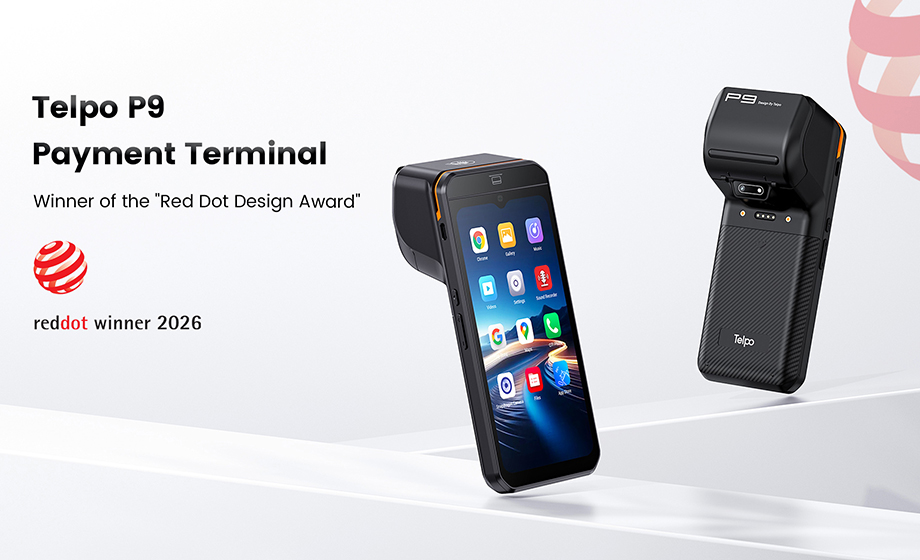
Table of Contents
What the Red Dot Award Means for a Portable Card Swipe Machine
For enterprise buyers evaluating payment hardware, a Red Dot Award signals that a product has been independently verified to meet the highest global standards in both design excellence and functional performance — a meaningful benchmark in a market crowded with superficially similar devices.
The Red Dot Design Award has recognized outstanding product design since 1955. Its jury evaluates submissions not on aesthetics alone, but on the coherence between visual intent, user experience, material choices, and engineering execution. For a portable card swipe machine operating in demanding commercial environments — restaurants, retail floors, field services — this holistic evaluation is precisely what separates genuinely well-designed hardware from devices that merely look the part in a product photo.
Telpo C9 & P9 Win Red Dot Award 2026 marks the second consecutive year Telpo has earned this recognition — following the M8 and M10 winning in 2025 — establishing a track record rather than a one-off achievement. As one of the few portable card reader machine red dot award 2026 recipients recognized on both design and engineering merit, the P9 sets a new reference point for what handheld payment hardware can look and perform like.
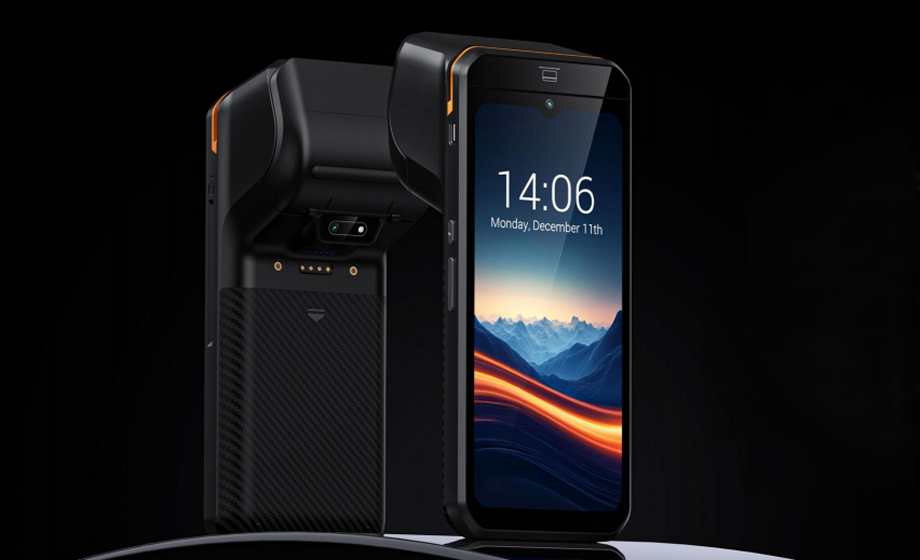
The P9’s design starts from a clear creative premise: efficiency tool aesthetics. Every visual decision — geometry, color, material, proportion — is resolved in service of that idea, producing a device that looks and feels fundamentally different from conventional handheld POS hardware.
Traditional handheld payment terminals are typically bulky, visually generic, and ergonomically compromised by the need to pack multiple components into a rectangular form. The P9 breaks from this convention through reconstructed geometric lines and a slimmer structural profile that creates a strong, immediately recognizable product identity.
The primary color scheme — black body with functional orange accents — delivers high visual distinctiveness in a market where most terminals default to grey or white. The carbon fiber texture rear cover and screwless exterior finish reinforce a sense of professional quality and brand value that carries through from first impression to extended daily use.
Good ergonomics in a payment terminal is not about comfort alone — it is about reducing staff fatigue across hundreds of daily transactions and minimizing the cognitive friction that slows down each customer interaction.
The P9’s grip zone uses a curved surface design contoured to fit the palm naturally, with weight distribution calibrated to reduce wrist fatigue during extended use. Straight lines, chamfered edges, and carefully considered geometric proportions create a compact, ordered form that feels deliberate rather than arbitrary in the hand.
The carbon fiber texture rear cover serves a dual purpose: it reinforces the premium visual identity established by the screwless exterior, and provides enhanced grip stability during one-handed operation — a practical benefit for staff handling the device continuously in fast-paced restaurant eftpos and retail environments.
The result is a device that looks sharp and precise but feels warm and accessible — a balance between professional authority and everyday usability that the Red Dot jury specifically recognizes in its evaluation criteria.

The P9 is positioned not as a payment device but as a three-in-one commercial terminal — integrating transaction processing, identity verification, and receipt printing in a single unit that does not compromise on any of the three.
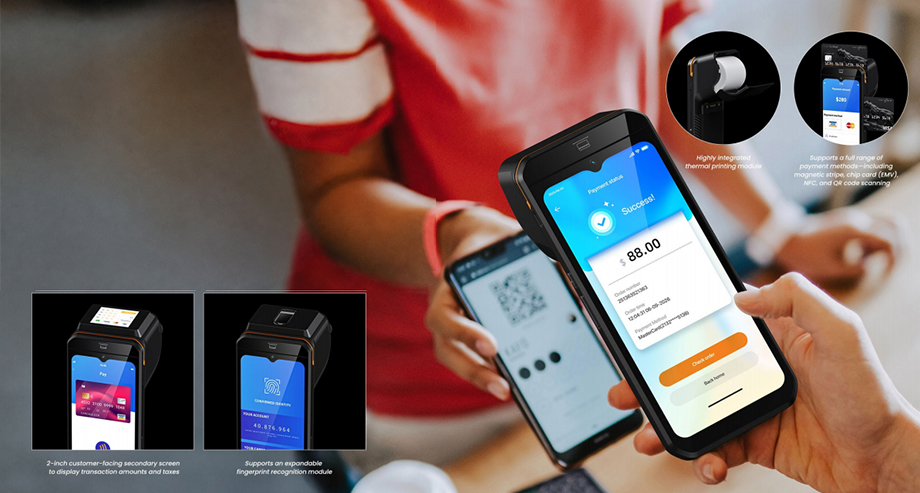
As an android pos machine, the P9 accepts every mainstream payment credential:
-
Magnetic stripe cards
-
EMV chip cards (contact and contactless)
-
NFC contactless — functioning as a full nfc payment machine compatible with digital wallets including Apple Pay
-
QR code scanning for app-based payment platforms
The integrated thermal printer runs at 80mm/s with 58mm paper width, outputting receipts without increasing device thickness and maintaining the slim profile that defines the P9’s visual identity. For businesses that need a credit card machine with printer in a compact, portable format — particularly in restaurant eftpos environments where tableside payment and instant receipt output are both expected — the P9 delivers this without the bulk that typically accompanies integrated printing. It is, in effect, a complete nfc payment machine with printer for restaurant eftpos deployments where speed, receipt output, and contactless acceptance must coexist in one handheld unit.
Two optional expansions extend the P9’s capability into specialized deployment contexts:
-
2-inch secondary customer display — shows transaction amount and tax breakdown to the customer during payment, improving transparency at the point of sale
-
Fingerprint recognition module — supports biometric identity verification and secure payment authentication, particularly relevant for deployments in African markets where identity verification requirements are integrated into the payment workflow
This modular approach makes the P9 a point of sale card reader that adapts to different market requirements without requiring a different base device for each scenario.
Lightweight Engineering: Looking Light and Being Light
The P9 achieves a dual objective that most hardware designs treat as competing priorities: it looks visually slender and it is physically light — and both qualities are the result of deliberate engineering rather than compromise.
At the visual level, the precise handling of line ratios and proportions creates a perception of length and slimness that differentiates the P9 from conventionally proportioned handheld terminals. At the engineering level, a high-integration layered internal structure reduces redundant components, and composite materials lower overall device weight — achieving what most credit card machine with printer compact portable design solutions struggle to deliver: a device that is genuinely light to carry and visually refined without sacrificing print capability.
For staff operating a portable card swipe machine throughout a service day — taking tableside payments, processing queue transactions, or verifying identities in the field — this weight reduction translates directly into reduced physical fatigue and a more confident, natural handling posture.
Sustainability: Designed with a Longer View
Sustainability in hardware design is increasingly a procurement criterion for enterprise buyers, and the P9’s material and manufacturing choices reflect a genuine commitment to reducing environmental impact across the product lifecycle.
The P9’s chassis uses a recyclable ABS+PC composite material that meets both RoHS and REACH compliance standards — covering restrictions on hazardous substances throughout the manufacturing process. The one-piece molding process reduces total component count, which lowers manufacturing energy consumption and simplifies end-of-life disassembly and recycling.
The device’s structural design prioritizes repairability, extending useful product lifespan and reducing the frequency of full device replacement. Packaging uses biodegradable or recyclable materials throughout, supporting green supply chain requirements that enterprise procurement teams are increasingly required to document and report.
Security and Compliance Across Every Payment Method
A payment terminal’s design credentials mean nothing if its security architecture does not meet the standards required by financial institutions and card schemes operating in regulated markets.
The P9 carries a comprehensive certification stack that covers the full spectrum of international compliance requirements. It is certified under PCI PTS 6.X for PIN transaction security, EMV L1 and L2 for chip card interoperability, EMV Contactless L1 for NFC transactions, and Visa Paywave and Mastercard Paypass for the two largest global card scheme networks.
For enterprise buyers evaluating a card payment machine for deployment across regulated markets — banking, retail, hospitality, government services — this certification stack significantly reduces compliance risk and accelerates the approval process with acquiring banks and payment processors. Telpo offers a range of eftpos machine options across different form factors, ensuring that security and compliance standards are maintained consistently across the full product portfolio.
The P9’s Red Dot recognition is not an isolated achievement — it reflects a consistent design and engineering philosophy applied across Telpo’s product lines.
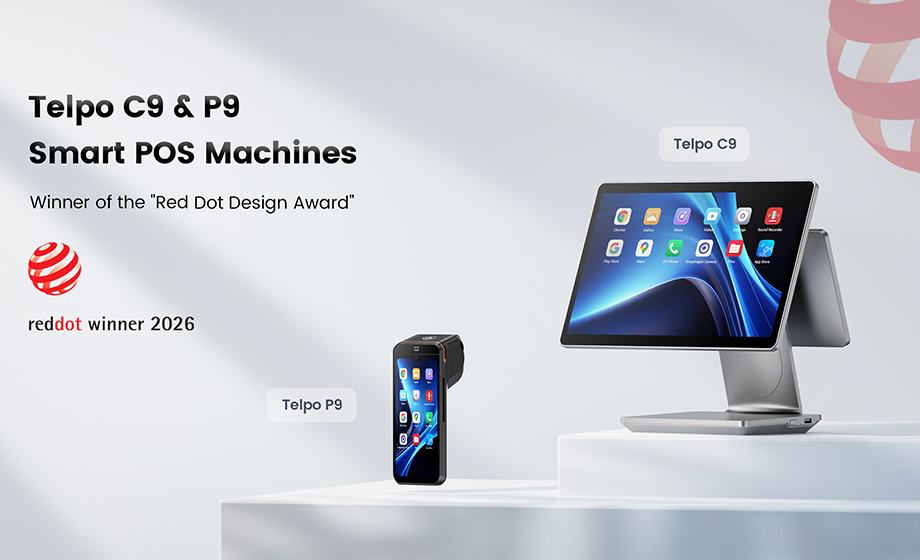
In 2025, the Telpo M8 and M10 dual-screen smart POS terminals earned Red Dot recognition for the same qualities: industrial-grade performance delivered through a refined, user-centered design. In 2026, the C9 desktop POS and P9 handheld terminal extended that record. Two consecutive years, four recognized products — a pattern that signals organizational commitment rather than circumstantial success.
For system integrators and enterprise buyers who present hardware to end clients, this consistency matters. Deploying terminals from a manufacturer with a documented track record of design recognition simplifies vendor justification and strengthens the overall hardware proposal.
Telpo’s Customization Capability Behind Every Product
Behind every Telpo terminal — including the P9 — is a customization and R&D infrastructure that allows the same design quality to be adapted to specific market requirements, brand identities, and operational contexts.
Telpo’s POS design and ODM capability is built on 200+ R&D engineers and a track record of 500+ customization projects delivered for clients including Alipay, MTN, Vodafone, Kakao Pay, and Payt. The customization process covers every stage from industrial design and mechanical engineering through mockup production, PCB development, mold making, trial production, and mass manufacturing — a one-stop service that eliminates the complexity of managing multiple specialized vendors.
For enterprise clients and system integrators who need a card reader machine adapted to a specific regional market, branded to a client’s identity, or configured with non-standard hardware modules, this depth of customization capability is a meaningful differentiator that goes beyond what most terminal manufacturers can offer.
Conclusion
The Telpo P9’s position on the red dot award products list is the outcome of design decisions made at every level of the product — from the efficiency-tool aesthetic that drives the visual language, to the ergonomic grip geometry, the integrated printer that preserves the slim profile, the modular expansion options that extend deployment flexibility, and the sustainable material choices that reflect a longer view of product responsibility.
For businesses evaluating their next portable card reader machine — whether for restaurant eftpos, retail checkout, field services, or financial inclusion programs — the P9 represents hardware where design quality and operational performance have been resolved together rather than traded against each other.
Explore the full P9 specification as an android pos machine, or browse Telpo’s complete range of eftpos machine options to find the right terminal for your deployment requirements.
FAQ
Q1: What criteria does the Red Dot Award evaluate, and why does it matter when choosing a portable card swipe machine for enterprise deployment?
The Red Dot Award evaluates products across innovation, functionality, ergonomics, quality, and the coherence between visual design and user experience. For enterprise buyers choosing a portable card swipe machine, this independent evaluation provides an objective benchmark that goes beyond manufacturer claims — confirming that the device has been assessed by an international jury of design experts and found to meet the highest global standards. In practical terms, Red Dot recognition in payment hardware correlates with better usability, lower staff fatigue, and a more professional customer-facing impression at the point of sale.
Q2: How does the Telpo P9 function as both an NFC payment machine and a credit card machine with printer without increasing device bulk?
The P9 achieves this through a high-integration layered internal structure that consolidates the NFC reader, EMV chip card module, magnetic stripe reader, and 80mm/s thermal printer within a single compact chassis — without increasing device thickness to accommodate the printer module. The composite material construction and reduced component count keep overall weight low, and the carbon fiber texture rear cover maintains grip stability despite the slim profile. The result handles NFC contactless, chip, swipe, and QR code payments and prints receipts in one unit, with the physical dimensions of a standard handheld terminal.
Q3: What should a restaurant or retail operator look for when comparing eftpos machines from different manufacturers, beyond price and certification?
Beyond price and compliance certifications, restaurant and retail operators should evaluate three factors. First, ergonomic design — staff use eftpos machines continuously across full shifts, and grip comfort, weight distribution, and interface clarity directly affect transaction speed and error rates. Second, integration depth — a terminal that consolidates payment, printing, and optional customer display in one unit reduces counter complexity and maintenance overhead compared to multi-device setups. Third, customization and ODM capability — for operators with specific branding, market, or hardware requirements, a manufacturer with documented customization experience and in-house R&D capacity can adapt the terminal to those requirements without compromising on core device quality.