
McDonald’s was the QSR chain to introduce and deploy self-ordering kiosks on a global scale. This strategy helped McDonald’s change the game and become the largest fast-food giant. Why is McDonald’s so persistent in offering self-ordering in its stores around the world?
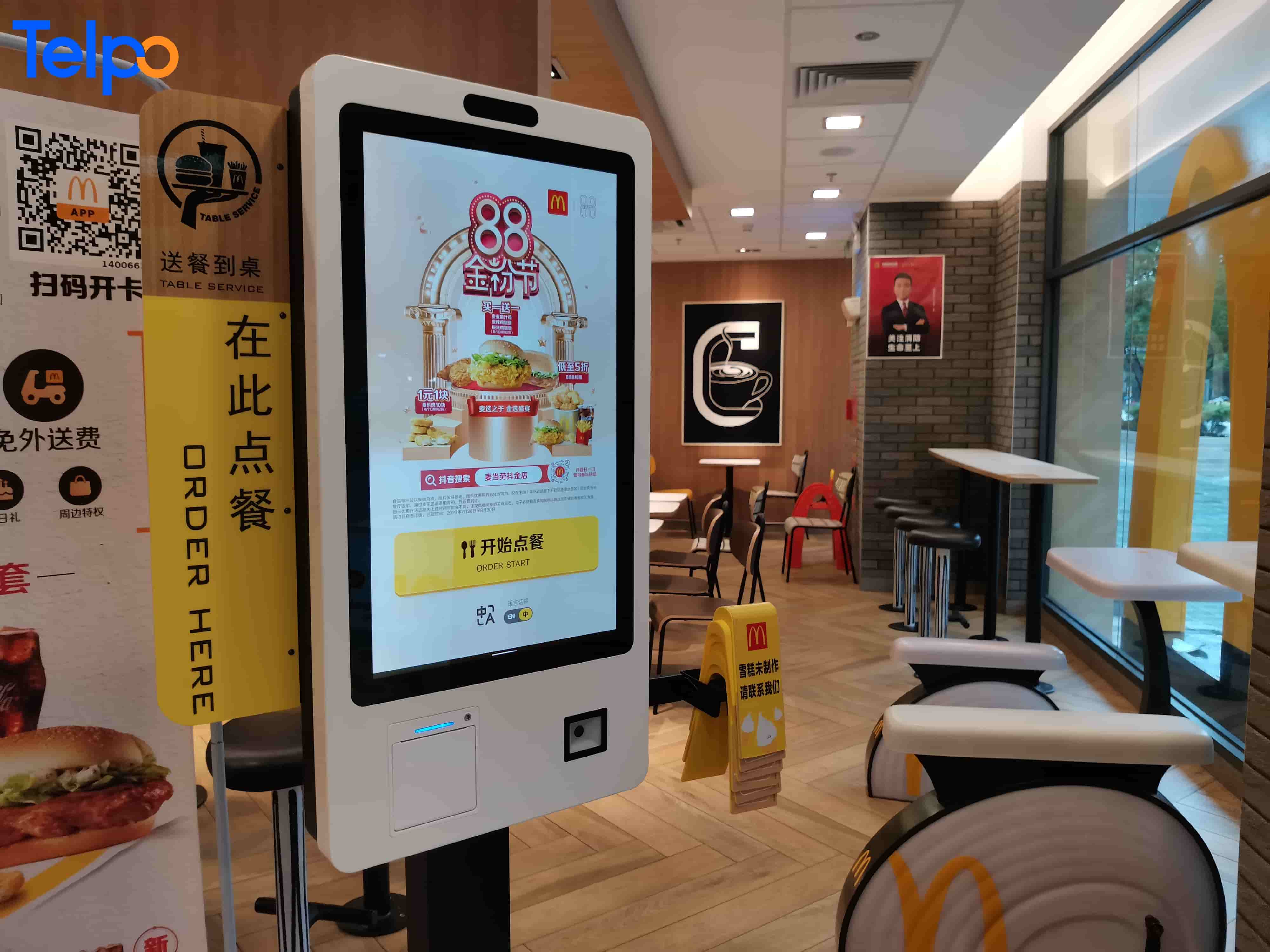
1. Order more
The data shows that customers can order more through the self-service method. The digital self-ordering machines encourage customers to order more by displaying menu combinations, special offers, and promotions. They can also customise a personalised menu for customers based on their previous habits.
2. Comfortable dining environment
Deploying self-service kiosks provides a more comfortable dining environment for customers. The self-service kiosks take up a small footprint and are concentrated in small areas, which leaves a more spacious area for customers to enjoy their food. At the same time, the kiosk machines can shorten the long line in front of the cashiers, and a more comfortable dining environment is created.
3. Standardised service level
McDonald’s is well-known for its standardised service that is customers can enjoy the same level of service and dishes no matter which store. Humans are uncontrollable, and the service attitude and ability of employees in different stores may be different. The self-ordering kiosks can eliminate this difference. Machines can treat every customer equally and deepen the standardised service level of McDonald’s.
4. Give customers more autonomy
Customers obtain more autonomy in ordering by using self-ordering machines. They could flexibly build their menus totally according to their own tastes and specifications. They don’t have to consider others’ opinions if they would like to remove tomatoes from their hamburgers. They could decide the time they spend browsing the menu without worrying about the invisible pressure from cashiers.
5. Multilingual support
It’s difficult for humans to grasp multiple languages, but it’s easy for machines to do that. Self-service kiosks in McDonald’s support multiple languages and allow customers to interact with machines in the language they prefer. This is especially important for foreign visitors. The multilingual support provided by kiosks avoids the situation of turning customers away because of language barriers.
6. Vivid menu display
Used as a digital menu board, the self-service kiosk provides an intuitive interface to show dish options and makes them more visually appealing. The large touchscreen with high definition can vividly display the pictures of each item, and customers can instantly know what it is without asking other people.
7. Elevate ordering speed
The core of fast food service is to be fast. If customers have to spend a lot of time waiting in line to order, it is contrary to the concept of quick service restaurants. McDonald’s deploys tens of self-service kiosks in its stores, which provide more choices for customers to order. They don’t have to wait in front of a limited number of cashiers. The kiosks speed up the ordering journey of customers.
8. Reduce ordering errors
The traditional way of ordering food is customer-cashier-kitchen transmission, and mistakes can happen in each loop. By contrast, self-service kiosks are less likely to make mistakes, for the ordering details can be conveyed from customers to the back kitchen. By eliminating the middleman link, the probability of making an order error is greatly reduced.
9. Reduce operating costs
The labour cost is going high, and it is becoming more cost-effective to replace cashiers with self-ordering machines. Unlike cashiers who require shifts, the kiosks can operate all day long. Besides, the machines can be set to work as soon as they’re unpacked, without any training. Additionally, machine management is much easier than human management, and the operators can upgrade the machines remotely and effortlessly.
10. Better staff distribution
As machines replace the ordering tasks of part of the cashiers, more labour can be distributed to complete other tasks, such as clearing tables and making dishes. This conduct improves the service level of McDonald’s stores, provides higher-quality services for customers, and elevates their satisfaction.
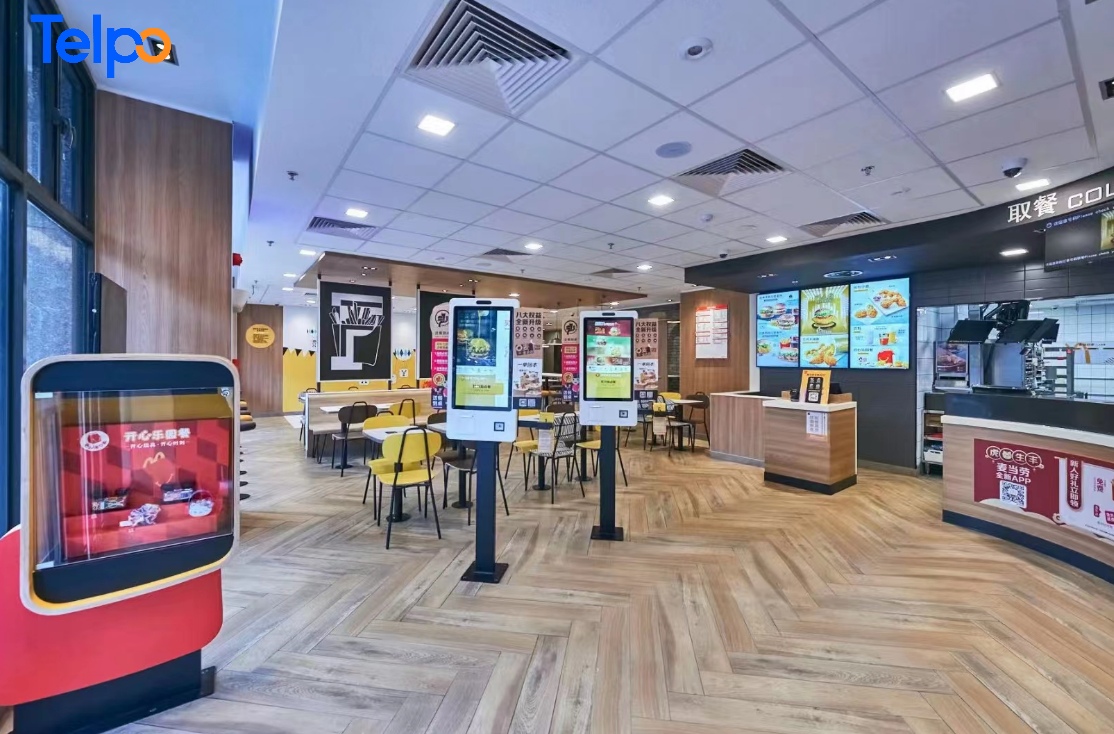
The success of McDonald’s with the self-ordering model becomes an example for other QSR chains. The other QSR giants like Burger King, Subway, Wendy’s, etc., capitalised on this advanced technology and introduced self-ordering kiosks to their stores on a large scale.
Compare to Self-ordering Kiosk and Traditional Cashier
| Self-ordering Kiosk | Traditional Cashier | |
| Order Value | 20–30% higher Upsells, combos & personalised suggestions shown visually at every order |
Lower Upselling depends entirely on cashier initiative and training |
| Ordering Speed (Peak Hour) | Higher throughput Multiple kiosks process orders simultaneously; no single-point bottleneck |
Limited by headcount Adding capacity requires hiring, scheduling, and training more staff |
| Order Accuracy | Up to 40% fewer errors Order goes directly from customer to kitchen — no verbal or manual transcription |
Error-prone Mishearing, typos, and miscommunication introduce errors at each handoff |
| Labour Cost | Significantly lower No wages, shifts, benefits, or turnover costs; one unit covers multiple cashier roles |
High & rising Minimum wage increases, training, scheduling, and staff attrition compound costs |
| Operating Hours | 24/7, no overtime Runs continuously without breaks, sick days, or shift changeovers |
Limited by shift schedules Extended hours require additional staffing and cost |
| Service Consistency | Identical every time Same menu, same presentation, same experience regardless of location or time of day |
Variable Depends on individual staff attitude, training level, and workload pressure |
| Multilingual Support | Instant language switching Full menu available in any configured language; critical for tourist-heavy locations |
Depends on staff skills Limited to languages each employee speaks; inconsistent across locations |
Telpo has rich experience in providing kiosks for quick service restaurants. The Telpo kiosk should be the preferred choice of McDonald’s, Burger King, and other QSR chains. In addition to providing reliable hardware, Telpo provides a full series of platform services covering Telpo MDM, Telpo APP Store, and Telpo OS to enhance device management and user experience. Welcome to contact us for more details. With 24 years of customisation and manufacturing experience, Telpo has the confidence to meet all your demands and make you satisfied!
FAQ
McDonald’s global kiosk integration extends beyond labor substitution; it is a fundamental re-engineering of the customer journey. Key strategic pillars include:
-
Intelligent Upselling Architecture: By leveraging AI-driven recommendation engines (Dynamic Yield), kiosks eliminate the variability of manual suggestive selling. This ensures consistent execution of high-margin add-ons and combo-upgrades, yielding a documented 20-30% uplift in Average Order Value (AOV).
-
Frictionless Personalization: The digital interface facilitates a pressure-free “build-your-own” environment. This Menu Transparency empowers granular customization, significantly enhancing customer satisfaction and Order Accuracy while mitigating communication barriers.
-
Strategic Labor Reallocation: Transitioning from a transactional focus to a hospitality-centric model, McDonald’s utilizes kiosks to reassign staff to the dining room. This Table Service initiative transforms the guest experience from self-service to premium-assisted service.
-
Immersive Menu Discovery: High-fidelity visual assets and streamlined navigation optimize the Menu Engineering strategy, reducing “cognitive load” and accelerating the path-to-purchase compared to conventional static menu boards.
Q2: What specific actions do McDonald’s kiosks take to drive the Loyalty Program?
McDonald’s has seamlessly integrated its MyMcDonald’s Rewards into the kiosk ecosystem to bridge the gap between digital and physical footprints:
- Omnichannel Identity (Single Sign-on): Customers can identify themselves at the kiosk by scanning a QR code from their mobile app or entering a 4-digit code. This enables the kiosk to recognize the user instantly, syncing their profile across Mobile Order & Pay, Drive-Thru, and In-store.
- Personalized Menu Decisioning: Once logged in, the kiosk displays “Favorites” and “Recent Orders”, significantly reducing the time-to-order for loyalists. It also tailors upselling suggestions based on the user’s past purchase behavior.
- Seamless Points Redemption: The kiosk interface allows users to view their points balance in real-time and select rewards for immediate redemption. This “Earn & Burn” visibility encourages repeat visits and deepens engagement with the digital ecosystem.
- Exclusive Digital Offers: Limited-time deals (LTOs) and app-exclusive coupons are automatically applied at the kiosk checkout, ensuring that the Value Proposition is consistent across all touchpoints.
-
Revenue uplift — kiosk orders consistently produce higher average check values (typically 20–30% above cashier orders) due to visual upselling and combo suggestions.
-
Labour savings — reducing cashier headcount or redeploying staff to value-added roles lowers your largest operating cost line.
-
Redundancy — deploying multiple kiosks (as McDonald’s does) means a single unit going offline does not create a service bottleneck. Cashier stations provide an additional fallback.
-
Remote diagnostics — platforms like Telpo MDM provide real-time device health monitoring, alerting operators to hardware issues before they escalate and enabling remote software recovery without an on-site visit.
Q3: What are the hardware features and technical characteristics of McDonald’s kiosks?
From self-service machines providing experience, McDonald’s kiosk terminals prioritize cross-platform versatility and rapid secondary development, supporting both Windows (Mainstream) and Android environments. To ensure seamless integration with complex backend systems, the hardware is backed by standardized, well-documented API/SDK sets. This technical foundation is complemented by a modular internal layout that facilitates rapid field-replacement of peripherals, maximizing uptime in 24/7 high-traffic commercial environments.
Globally, the hardware adheres to stringent benchmarks like ADA (Accessibility) while maintaining the flexibility to meet specific national market-entry protocols. The system supports diverse deployment formats—including pedestal-mounted (single/double-sided), wall-mounted, and compact counter-top units—coupled with unified payment versatility (EMV/NFC) to ensure consistent throughput efficiency across all store footprints.