
Workplace canteens across Europe are under pressure to serve more people, faster, with fewer staff — all while keeping the lunch experience pleasant. For one Norwegian canteen operator, the answer came in the form of food recognition AI embedded in a self-service checkout terminal. By deploying the Telpo C50 through a partnership between 4Service and Izy, the canteen replaced slow, staff-heavy checkout lines with an intelligent, autonomous self cash register — one that identifies dishes and processes payment in seconds.
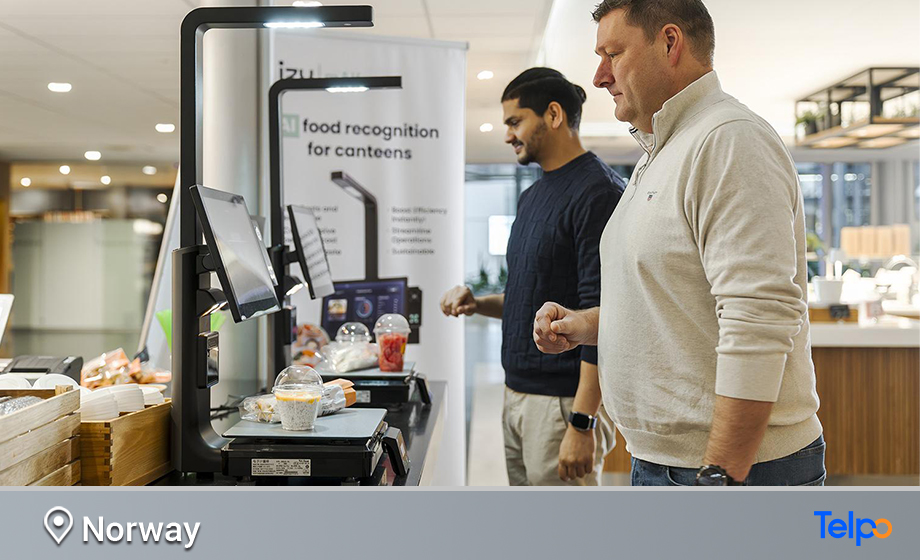
Table of Contents
Why Smart Canteens Are Rethinking the Touch Cash Register
The traditional canteen checkout model — staff manually entering or scanning each item — creates bottlenecks precisely when demand peaks. AI-powered self cash registers address this by removing the manual identification step entirely.
Lunch hour is unforgiving. Demand compresses into a 30-to-60-minute window, and every second at the checkout counter multiplies across the queue. Manual entry is slow, error-prone, and reliant on staff who need training, breaks, and coverage. For canteens serving hundreds of workers daily, the operational cost of this model adds up quickly.
The emergence of AI checkout machines offers a fundamentally different approach: instead of scanning barcodes or manually selecting items, a camera-based system identifies what is on the tray in real time and calculates the total automatically. For food service operators, this means faster throughput, fewer errors, and staff freed from repetitive checkout tasks.
How Telpo C50 Automatic Cash Register Machine Powers AI-Driven Checkout in Norway
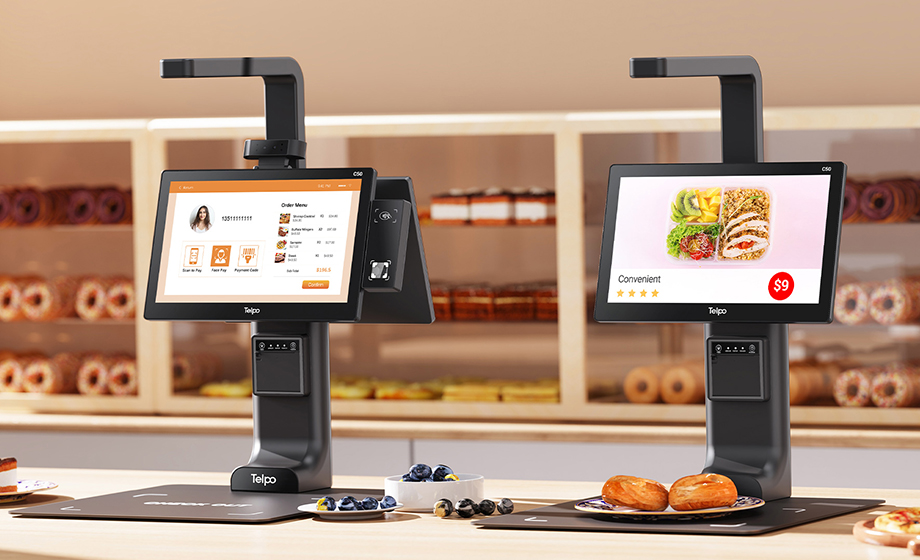
The Telpo C50 is an Automated Cash Register with built-in AI vision technology, purpose-built for food service environments where speed, accuracy, and ease of use are non-negotiable.
In Norway, Telpo C50 is used for smarter canteen operations through the mAIfood platform developed by Izy — combining Telpo’s hardware with intelligent food recognition software to create a seamless, staff-optional checkout experience.
AI Vision Recognition: 0.1-Second Item Identification
The C50’s food recognition engine identifies items in just 0.1 seconds with a 99.8% recognition accuracy rate — covering both barcoded and non-barcoded products including prepared dishes, fresh items, and packaged goods. Overall checkout efficiency improves by up to 3x compared to traditional manual checkout, directly reducing queue length during peak lunch periods.
Full Self-Checkout and Assisted Checkout Modes
The C50 supports two operational modes, making it adaptable to different canteen staffing models:
-
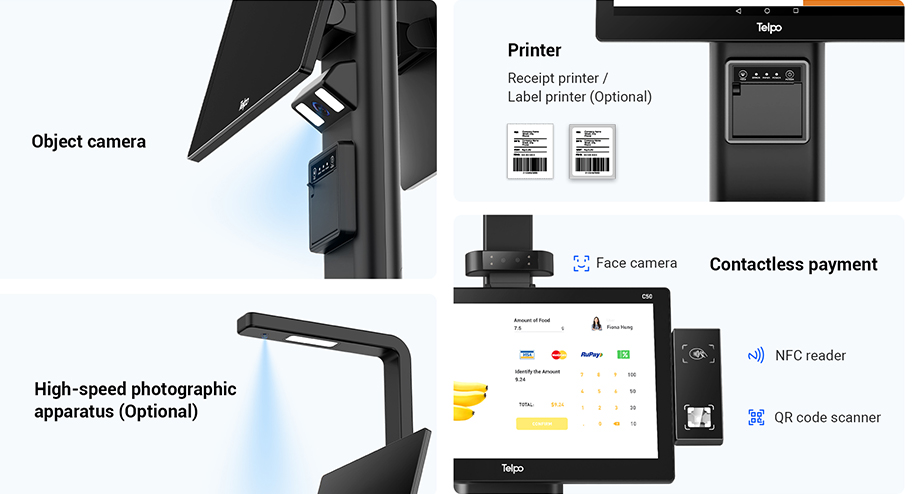
Unattended self-checkout — customers place their tray, the AI identifies items automatically, and payment completes via QR code or NFC contactless tap with no staff involvement
-
Assisted checkout mode — in staff-present configurations, AI recognition eliminates manual item entry, reduces training time, and removes input errors, allowing staff to focus on customer interaction rather than data entry
An optional dual-screen setup supports customer-facing display and promotional content during the transaction — adding a revenue opportunity alongside the operational efficiency gain.
Flagship AI Processing Power
Underpinning the C50’s recognition speed is a robust hardware stack: an octa-core 2.7GHz processor, Adreno 642L GPU, and up to 12 TOPS of AI compute running on Android 12-based Telpo OS. This processing headroom ensures the device handles real-time AI recognition tasks without latency — even during high-volume lunch rushes where multiple transactions run simultaneously.
What Food Recognition AI Delivers for Canteen Operations
Deploying a food recognition AI checkout terminal does more than speed up transactions. It changes the operational model of the canteen — reducing labor dependency, improving accuracy, and creating a measurably better experience for both staff and customers.
For canteen managers, the key operational benefits are:
-
Reduced staffing pressure — fewer staff needed at checkout during peak hours, reallocated to food preparation and service quality
-
Eliminated manual entry errors — AI visual identification replaces human item selection, removing a consistent source of billing mistakes
-
Faster table turnover — shorter queues mean more customers served within the lunch window without extending service hours
-
Lower training overhead — intuitive AI checkout interface reduces onboarding time for new canteen staff
-
Consistent pricing accuracy — automated recognition applies the correct price to every item, every time
-
Data-driven procurement forecasting — transaction history generated by the AI checkout system gives canteen managers accurate demand data, enabling more precise food ordering, less over-preparation, and measurable reduction in food waste — directly improving canteen profitability over time
Manual Checkout vs. AI Checkout: A Side-by-Side Comparison
| Traditional Manual Checkout | Telpo C50 Food Recognition AI Checkout | |
| Item identification | Manual entry or barcode scan by staff | AI vision recognition in 0.1 seconds |
| Recognition accuracy | Variable, subject to human error | 99.8% accuracy rate |
| Checkout speed | Dependent on staff pace and queue length | Up to 3x faster than manual checkout |
| Staffing requirement | At least one staff member per checkout lane | Fully unattended or minimal staff oversight |
| Non-barcoded items | Requires manual lookup or memorization | Automatically recognized by AI |
| Payment methods | Often cash or single terminal | QR code, NFC contactless, multiple digital methods |
| Staff training time | Significant — menu knowledge required | Minimal — AI handles item identification |
| Peak hour performance | Degrades as queue grows | Consistent regardless of volume |
| Food waste management | No data-driven insight | Procurement forecasting via transaction history |
| Customer experience | Queue-dependent, variable wait times | Fast, independent, self-directed |
What Operators and Partners Say
Feedback from the Norway deployment reflects both the practical realities of introducing new checkout technology and the operational value it delivers once in place.
“It can take some time to scan images, but once that’s in place, the device is easy to use,” says Øivind from 4Service.
“mAIfood solves problems for both customers who want their lunch quickly. It frees up time for canteen staff and simplifies canteen operations,” says Saurav Pandey from Izy.
Both observations point to the same conclusion: the initial image training investment pays off in sustained operational simplicity. Once the system learns the canteen’s menu, the touch cash register experience becomes intuitive for customers and largely hands-off for staff.
How Telpo’s Hardware Portfolio Supports Diverse Payment and Retail Scenarios
The Telpo C50 is one part of a broader portfolio of intelligent terminal hardware designed to serve different payment and retail scenarios — from high-volume self-checkout to counter-based assisted payment and mobile point-of-sale deployments.
For operators managing multiple service formats — a staff canteen alongside a retail grab-and-go area, or a food court with mixed vendor types — a single device category rarely covers every scenario. Telpo’s range of smart payment solutions and retail pos solutions provides the hardware flexibility to deploy the right terminal at each touchpoint without sourcing from multiple vendors.
This portfolio approach is particularly relevant for enterprise clients and system integrators who need consistent hardware standards, unified software compatibility, and a single support relationship across diverse deployment contexts.
Conclusion
The Norway canteen deployment demonstrates what food recognition AI looks like in practice: faster checkout, reduced operational complexity, fewer food waste, and a measurably better experience for customers who want their lunch quickly and staff who have better things to do than manually enter every item on a tray.
The Telpo C50 delivers this as a purpose-built checkout terminal — combining 0.1-second AI item recognition, 99.8% accuracy, and flexible self-service or assisted checkout modes in a single automatic cash register machine designed for the realities of food service environments.
For canteen operators, food service managers, and system integrators evaluating the next generation of smart checkout hardware, explore the full Telpo C50 specifications and contact the Telpo team to discuss deployment requirements for your operation.
FAQ
Q1: How does food recognition AI compare to barcode scanning for canteen checkout, and which is better for a high-volume lunch service?
Food recognition AI identifies items visually in real time — no barcode, no manual selection, no staff input required. For canteen environments where many items are prepared fresh without barcodes, and where checkout speed during a compressed lunch window directly affects how many customers get served, AI recognition outperforms barcode scanning on both speed and coverage. The Telpo C50 identifies items in 0.1 seconds with 99.8% accuracy, including non-barcoded dishes — making it significantly better suited to food service than barcode-dependent systems that require every item to be individually labeled.
Q2: What should a canteen operator consider when choosing a self checkout machine manufacturer for a workplace food service environment?
The most important considerations are recognition capability, operational flexibility, and integration support. A self checkout machine manufacturer should offer hardware that handles both barcoded and non-barcoded items, since most canteen menus include fresh and prepared dishes that cannot be individually labeled. The system should support both fully unattended and staff-assisted modes, so operators can adapt the checkout model to staffing levels and peak demand.
Q3: Can food recognition AI help canteen managers reduce food waste and improve procurement decisions?
Food recognition AI generates detailed transaction data on what is sold, when, and in what volume — giving canteen managers an accurate, ongoing picture of demand patterns. This transaction history enables more precise food ordering, reducing over-preparation of dishes that go unsold and the food waste that results. Over time, data-driven procurement decisions lower ingredient costs, improve menu planning accuracy, and contribute directly to canteen profitability — making the AI checkout system a business intelligence tool as much as an operational efficiency upgrade.