
Field operations teams have always needed a device that keeps up — with warehouse throughput, retail floor demands, and last-mile delivery pressure. The wireless PDA has been that device for decades, but most deployments still run on hardware that compromises somewhere: battery life that doesn’t cover a full shift, scan engines that fail on damaged labels, or build quality that doesn’t survive a concrete floor. The Telpo L5 is a new rugged handheld mobile device that removes those compromises — combining an octa-core Android 15 platform, a professional-grade scan engine, IP65 and 1.5-meter drop protection, and a 5000mAh swappable battery in a single device built for logistics, retail, and courier operations.
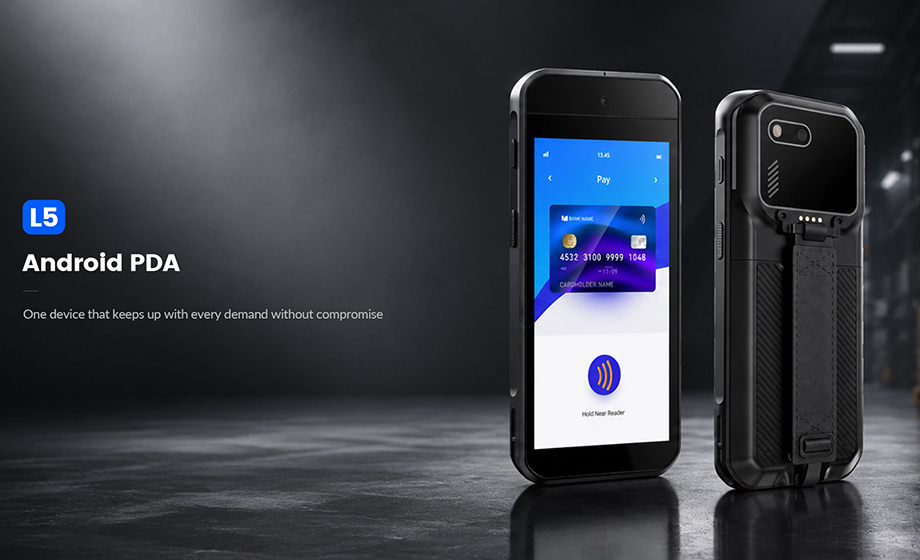
Table of Contents
Why Modern Operations Need a Smarter Wireless PDA
The operational demands on field hardware have outpaced what most legacy pda portable device devices were designed to handle — and the gap between what teams need and what aging hardware delivers is now a measurable source of operational inefficiency.
Warehouse throughput targets have increased. Retail inventory cycles move faster. Last-mile delivery volumes have expanded significantly, with each courier managing more stops, more documentation requirements, and more real-time data sync obligations per shift. A pda portable device that cannot sustain reliable scanning, payment processing, photo documentation, and network connectivity across a full working day creates friction at every one of those touchpoints.
The shift to Android-based wireless pda devices running enterprise applications has raised the bar further: devices now need to run multiple concurrent applications, handle over-the-air software updates, support remote device management across fleet deployments, and integrate with cloud-based inventory, routing, and CRM systems — all while surviving the physical conditions of the environments they operate in. The Telpo L5 is built to meet this expanded requirement set from the ground up.
Performance That Keeps Pace with High-Volume Field Operations
An octa-core 2.0GHz processor running Android 15, paired with 4GB RAM and 64GB storage, gives the L5 the processing foundation to handle concurrent enterprise applications without performance degradation across a full operational shift.
The Telpo L5 runs on Android 15 — the latest stable release — with an octa-core 2.0GHz processor and 4GB RAM / 64GB ROM as standard, upgradeable to 6GB RAM / 128GB ROM for deployments running more demanding application stacks. For logistics teams running warehouse management systems alongside real-time sync, retail staff managing inventory applications and mobile POS simultaneously, and courier teams processing route navigation alongside delivery confirmation workflows, this processing headroom means the device responds immediately rather than lagging under load.
The 5000mAh removable battery delivers up to 12 hours of continuous operation — covering an extended shift without a charging break. The swappable design allows immediate battery replacement at shift change, eliminating device downtime for operations running back-to-back service windows. For depot managers coordinating multi-shift warehouse operations, this means a single device fleet can cover continuous operation without requiring a spare device inventory sized to cover charging cycles.
Under-Display NFC and SoftPOS for Multi-Function Field Operations
The L5’s under-display NFC module with SoftPOS compatibility transforms the device from a scanning and data terminal into a multi-function field operations platform — handling payment acceptance, membership card reading, and employee identity verification on the same hardware.
Under-display NFC eliminates the need for a separate reader or payment terminal in scenarios where the pda portable device is already the primary field device. For retail staff processing mobile checkout on the floor, the L5 accepts contactless payment directly — no secondary device required at the point of interaction. For loyalty program management, membership card reading via NFC keeps the customer interaction at a single device. For enterprise security and workforce management, employee identity verification via NFC-based credentials is handled by the same device staff carry throughout their shift.
SoftPOS compatibility means the L5 can be configured as a software-based payment acceptance point, enabling contactless card and mobile wallet transactions without dedicated payment hardware — a meaningful cost reduction for operations that need mobile payment capability at multiple points across a retail floor or field service area.
A Professional Scan Engine That Handles Real-World Label Conditions
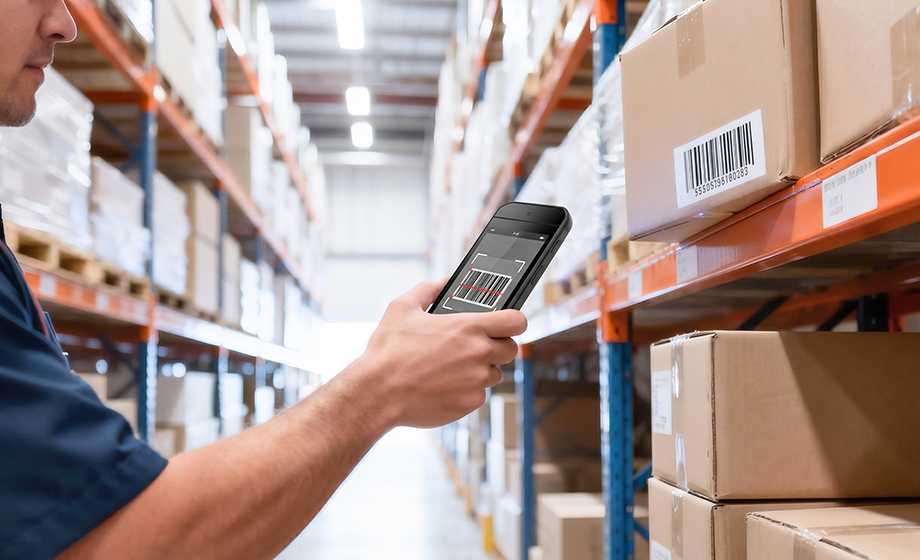
The L5’s professional-grade scan engine reads 1D and 2D barcodes reliably across all label conditions — including damaged, dirty, distorted, and screen-displayed codes — eliminating the scan failures that slow down receiving, picking, and delivery confirmation workflows.
Standard scan engines perform well on clean, undamaged labels in controlled conditions. In the actual environments where pda barcode scanner devices are used — receiving docks with wet or crushed packaging, warehouse shelves with worn labels, retail stockrooms with partially obscured codes, and delivery scenarios where customers present QR codes on phone screens — scan reliability degrades in ways that create measurable throughput loss.
The Telpo L5’s scan engine is specified for these conditions. It handles:
-
1D and 2D barcodes across all common formats
-
Damaged and dirty labels where standard engines produce read failures
-
Distorted codes on curved or irregular surfaces
-
Screen-displayed QR codes from customer phones, apps, and digital documents
For logistics teams processing inbound shipments where label quality is inconsistent, retail staff scanning shelf and product codes at varying angles, and courier teams processing customer QR codes for contactless delivery confirmation, this scan reliability translates directly into faster transaction completion and fewer manual override incidents per shift.
Built to Last: IP65, Drop Rating, and Industrial Durability
IP65 certification, a 1.5-meter drop rating onto concrete, and 2,000 tumble test cycles confirm the L5’s durability under the physical conditions of warehouse, retail, and field delivery environments — not just in controlled laboratory testing.
The Telpo L5 carries IP65 dust and water resistance — protecting against complete dust ingress and water jets from any direction. In warehouse environments where dust accumulation is continuous and cleaning with water is routine, in retail stockrooms where device exposure to liquids during receiving is common, and in outdoor delivery scenarios where rain is an operational reality, IP65 ensures the device functions without environmental degradation.
The 1.5-meter drop rating onto concrete covers the most common device damage scenario in field operations: a device dropped from working height onto a hard floor. Combined with 2,000 tumble test cycles, this certification confirms the L5’s mechanical resilience under the repeated handling stress of active daily use across a multi-year device lifecycle.
For fleet procurement managers calculating total cost of ownership across a device fleet, durability certifications translate directly into longer replacement cycles and lower per-device lifecycle cost — making the L5’s rugged specification an operational investment, not just a product feature.
Cameras, Stylus, and Connectivity for Complete Field Documentation
The L5’s dual-camera system, stylus support for electronic signature, and comprehensive wireless connectivity complete the field documentation capability that logistics, retail, and delivery operations require.
Dual-Camera System for On-Site Verification and Exception Documentation
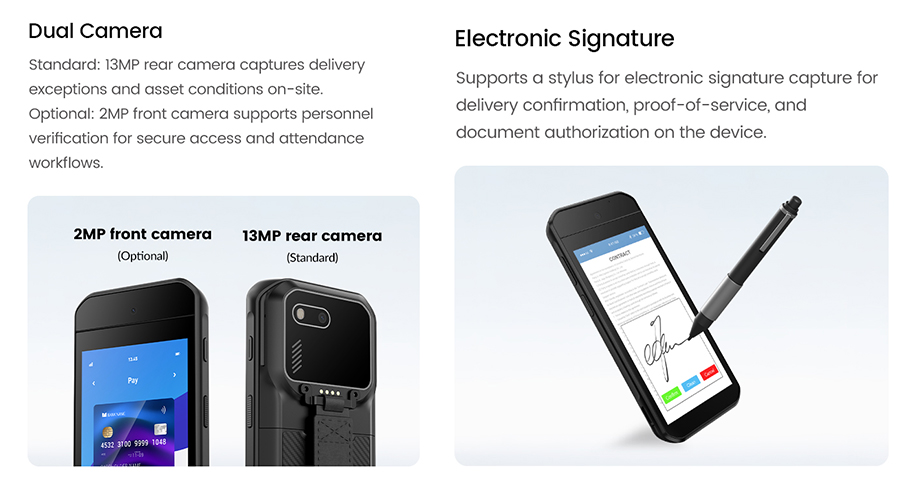
The 13MP rear camera provides the image quality needed for on-site photo documentation — damaged goods at receiving, shelf condition audits, delivery exception records, and site verification photos that serve as operational evidence in dispute resolution. The optional 2MP front camera supports personnel identity verification for secure device login and on-site staff authentication, covering access control requirements alongside operational documentation.
Stylus Support for Electronic Signature Capture
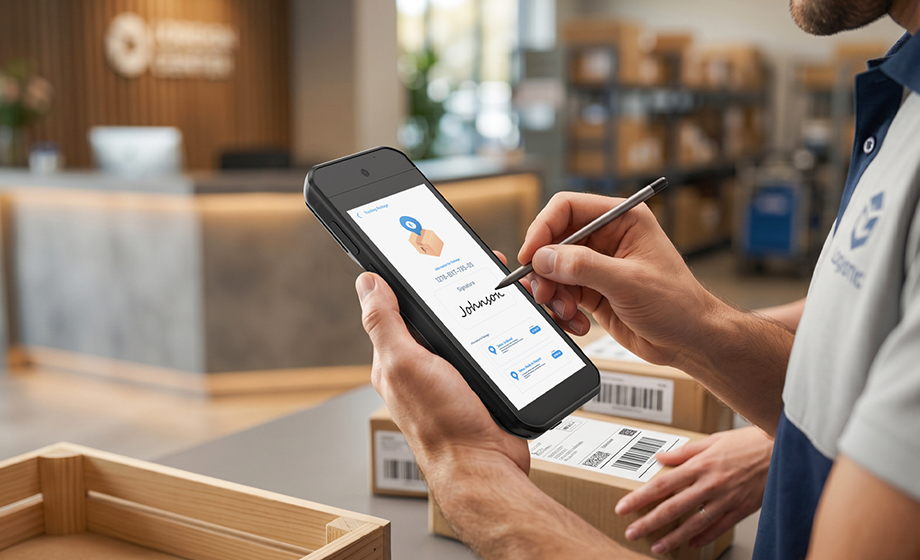
Stylus input support enables electronic signature capture directly on the L5 — replacing paper-based proof-of-delivery and authorization workflows with a fully digital process. For courier teams collecting recipient signatures at delivery, retail staff capturing customer authorization for returns or high-value transactions, and logistics teams documenting handover sign-offs, this eliminates the paper handling and manual transcription that paper-based signature workflows require.
Full Wireless Connectivity
The L5 supports Wi-Fi 2.4GHz and 5GHz, 4G LTE, Bluetooth, and GPS — providing seamless connectivity whether the device is operating within a warehouse Wi-Fi network, in transit between delivery stops on 4G, or in outdoor environments where GPS location tracking supports route optimization and delivery confirmation.
Where the Telpo L5 Performs: Three Core Deployment Scenarios
The L5’s combination of scan reliability, payment capability, camera documentation, and industrial durability makes it a complete field operations platform across logistics, retail, and courier deployments — replacing multiple single-function devices with one well-specified android pda.
Logistics and Warehousing
Receiving teams use the L5’s professional scan engine to process inbound shipments efficiently, including damaged and partial labels that standard scanners miss. Dynamic inventory counting, putaway verification, outbound picking confirmation, and transport check-in are all handled on a single pda portable digital assistant — with 12-hour battery life covering extended warehouse shifts and IP65 protection handling the physical environment without performance degradation.
New Retail and Store Operations
Retail staff use the L5 for floor-based price lookup, live inventory verification, product shelving confirmation, and mobile checkout via NFC SoftPOS — eliminating the need to return to a fixed terminal for each transaction type. Membership card reading via NFC supports loyalty program interaction at the point of customer engagement. Dynamic inventory counting during trading hours becomes practical with a device that handles scanning and data sync reliably across the full store shift.
Express Delivery and Last-Mile Operations
Courier teams use the L5 for parcel pickup and delivery confirmation, electronic signature capture, exception photography for damaged items, real-time route navigation via GPS, and instant data sync to dispatch systems via 4G. The modern pda device form factor allows all of these functions to operate from a single handheld unit that fits in a jacket pocket between stops — replacing the combination of scanner, signature pad, and phone that some courier operations still manage separately.
Conclusion
The Telpo L5 is a rugged handheld mobile device that consolidates the functions field operations teams currently manage across multiple devices — scanning, payment, documentation, navigation, and signature capture — into a single rugged handheld computer built for the physical realities of warehouse, retail, and delivery environments.
For logistics managers evaluating their next modern pda device fleet, retail operations teams replacing aging handheld scanners, and courier companies standardizing on a single field device across their delivery workforce, the L5 provides the specification depth and operational reliability that high-volume field deployments require.
Explore the full Telpo L5 specification as an android pda on the Telpo website, or contact the Telpo team for fleet pricing, MDM integration options, and deployment consultation tailored to your operation.
FAQ
Q1: What is the difference between a modern pda device and a standard barcode scanner, and when does an operation need the full PDA capability?
A standard barcode scanner reads codes and transmits data — that is its primary function. A modern wireless pda runs a full Android operating system, supports multiple enterprise applications simultaneously, handles payment acceptance via NFC, captures photos and signatures, provides GPS navigation, and maintains real-time connectivity via 4G and Wi-Fi. Operations that need only scanning and data capture can use a simpler scanner. Operations that need scanning alongside mobile checkout, delivery documentation, exception photography, electronic signature, and route navigation require a full pda portable device — because combining those functions in one device reduces the equipment staff carry and eliminates the workflow breaks that switching between devices creates.
Q2: How does a rugged handheld mobile device with IP65 and a 1.5-meter drop rating reduce total cost of ownership compared to standard commercial devices in warehouse and logistics deployments?
Standard commercial devices — consumer smartphones and tablets — are not rated for the drop heights, dust exposure, and liquid contact that warehouse and logistics environments produce daily. Replacement rates for unprotected devices in these environments are significantly higher than for IP65-rated, drop-tested hardware. A rugged handheld mobile device with IP65 and a 1.5-meter concrete drop rating sustains operational performance across a longer replacement cycle, reducing per-device annual cost even when the initial purchase price is higher. For fleet procurement teams managing hundreds of devices, the difference in replacement frequency over a three-to-five-year deployment lifecycle typically more than offsets the upfront cost premium of rugged hardware.
Q3: What should a logistics or retail operation evaluate when choosing a pda portable digital assistant for a multi-scenario deployment covering warehouse, store floor, and delivery?
Four criteria determine fit for multi-scenario pda portable digital assistant deployments. First, scan engine capability — the device must read damaged, distorted, and screen-displayed codes reliably, since label quality varies across receiving, retail, and delivery contexts. Second, battery life and replaceability — 12 hours of continuous operation with a swappable battery covers multi-shift deployments without charging infrastructure dependency. Third, payment and NFC capability — SoftPOS-compatible under-display NFC allows the same device to handle mobile checkout, loyalty card interaction, and employee verification without additional hardware. Fourth, connectivity breadth — Wi-Fi for warehouse and store environments, 4G for delivery routes, GPS for navigation and location tracking, and Bluetooth for peripheral integration across all three scenarios.